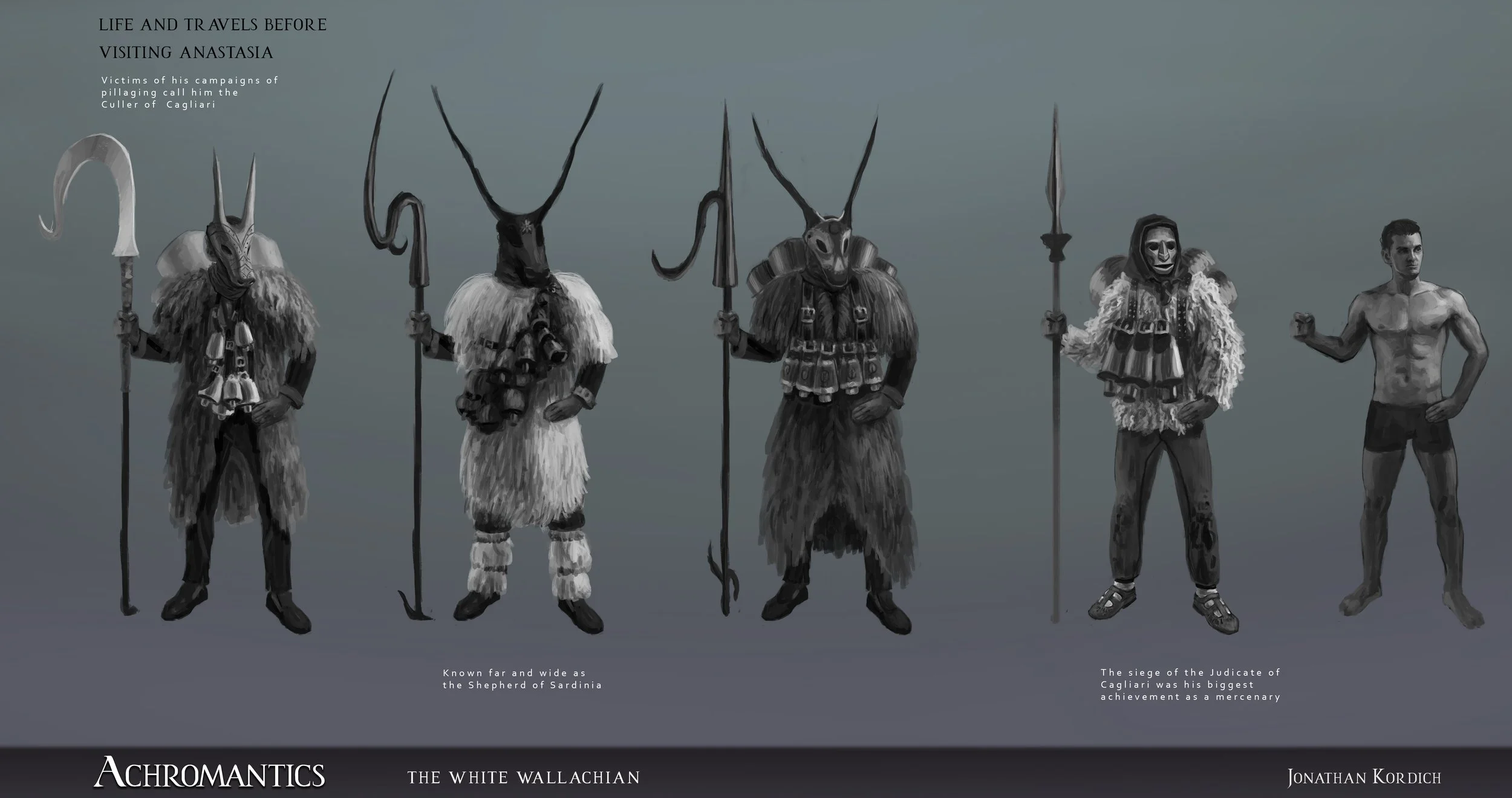
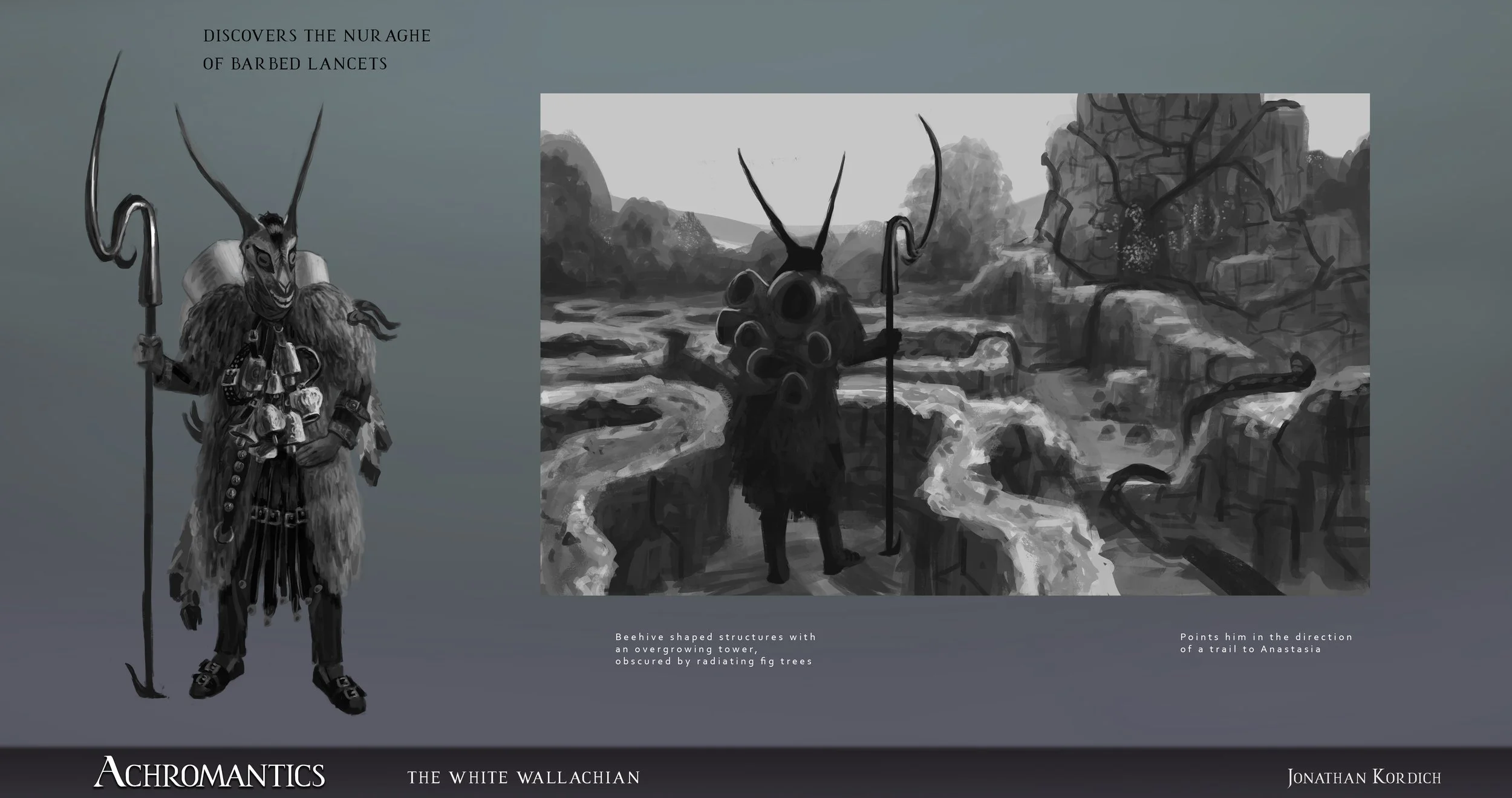
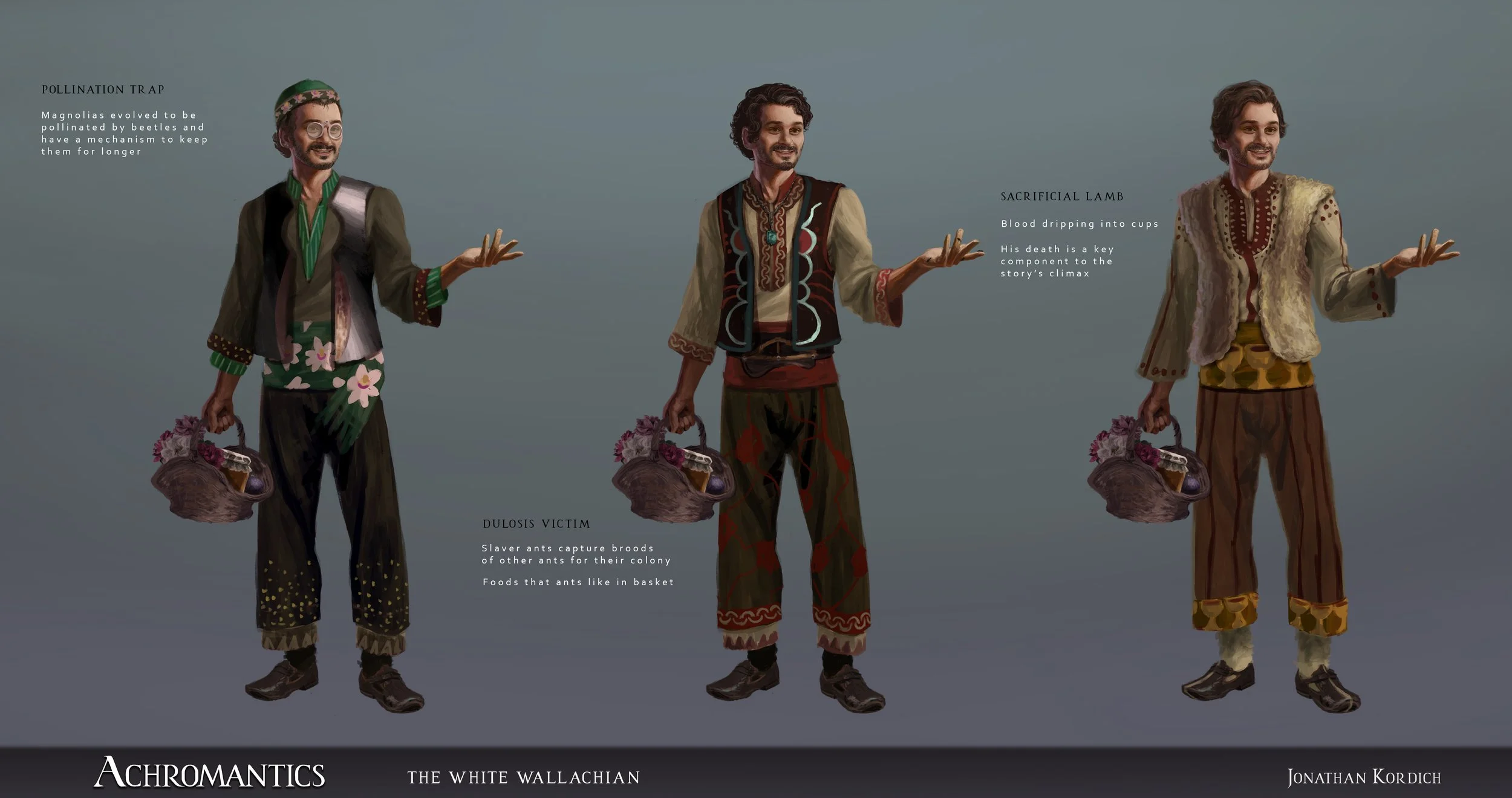
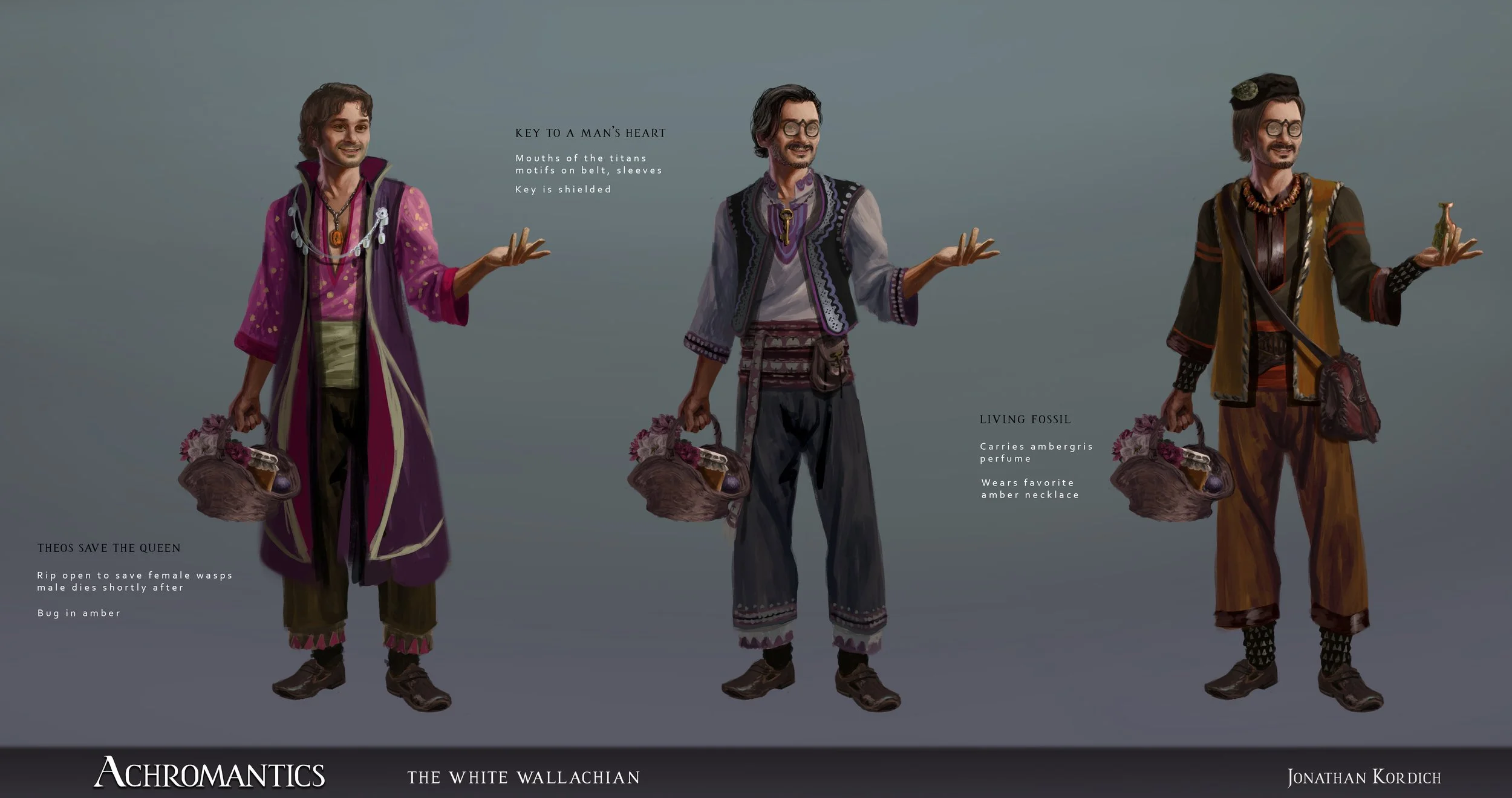
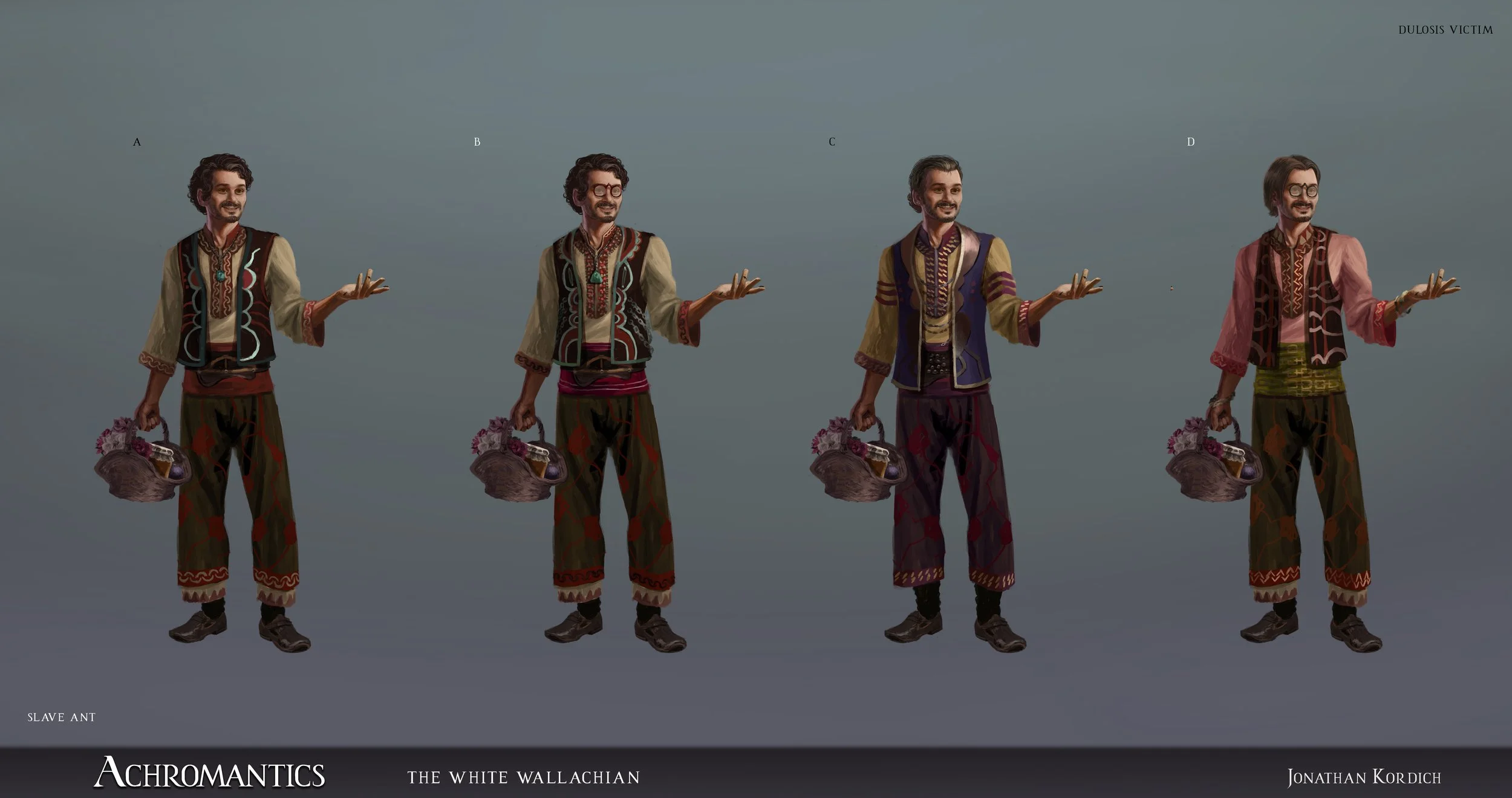
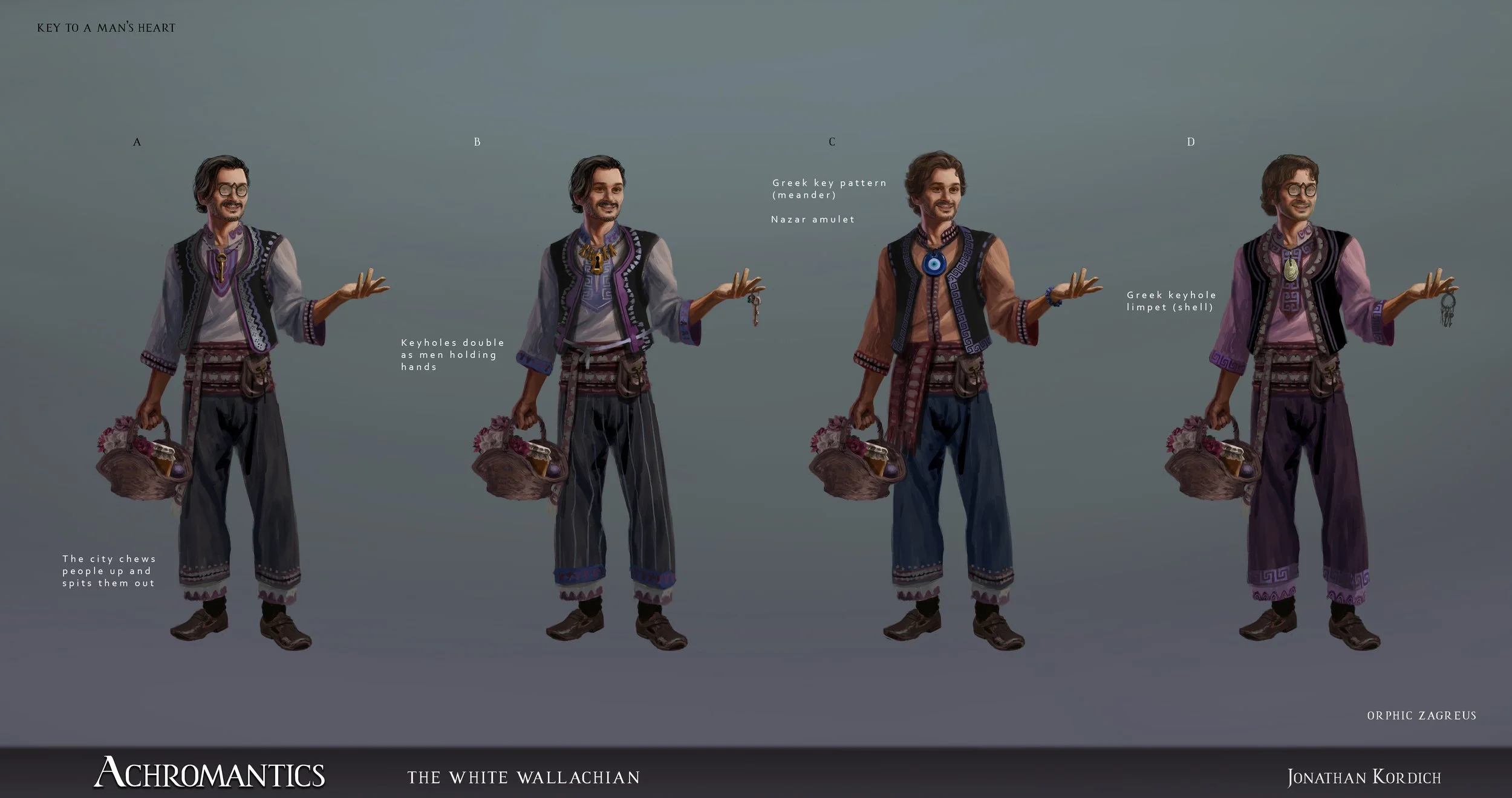
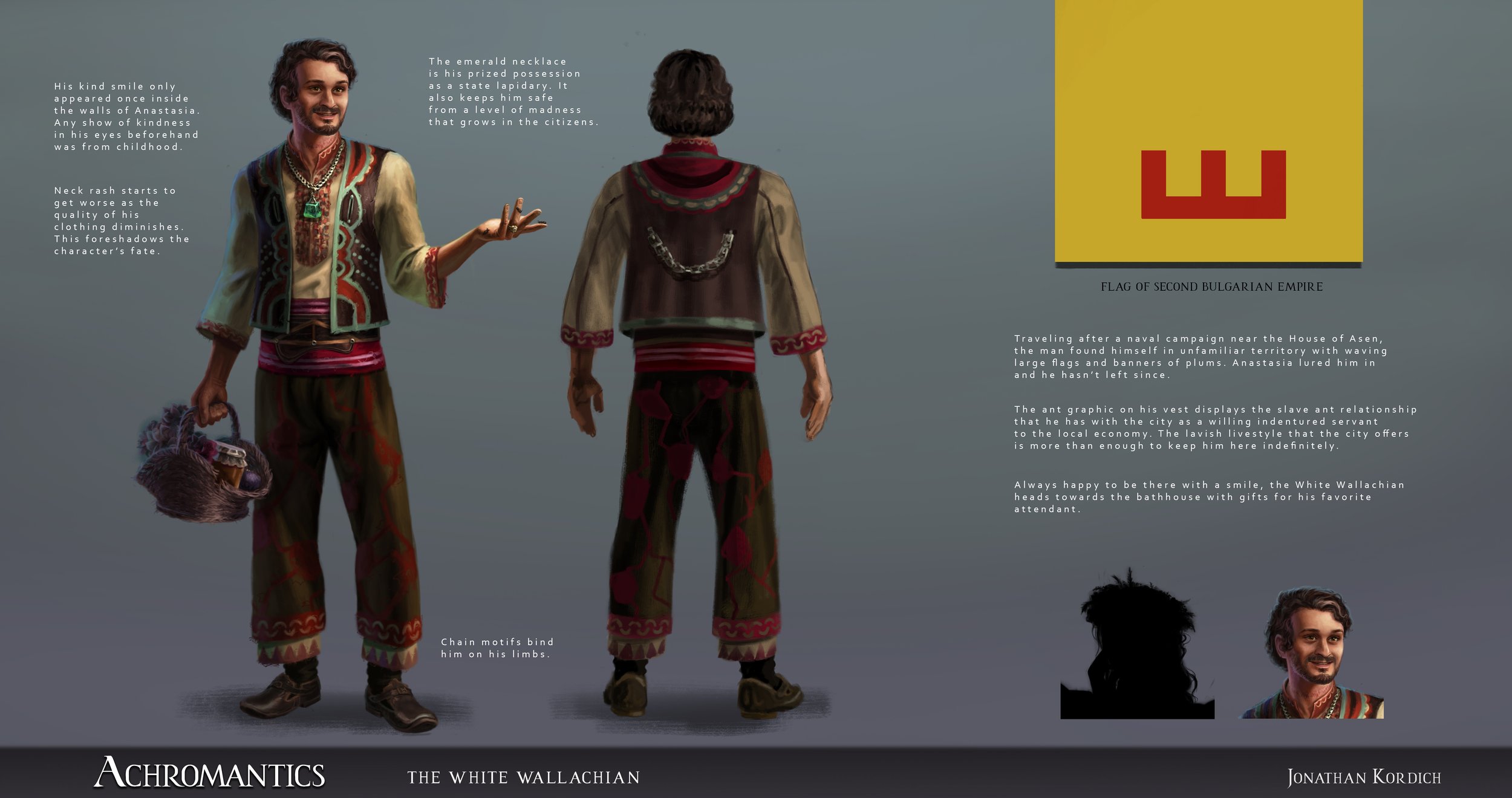



Achromantics - personal project
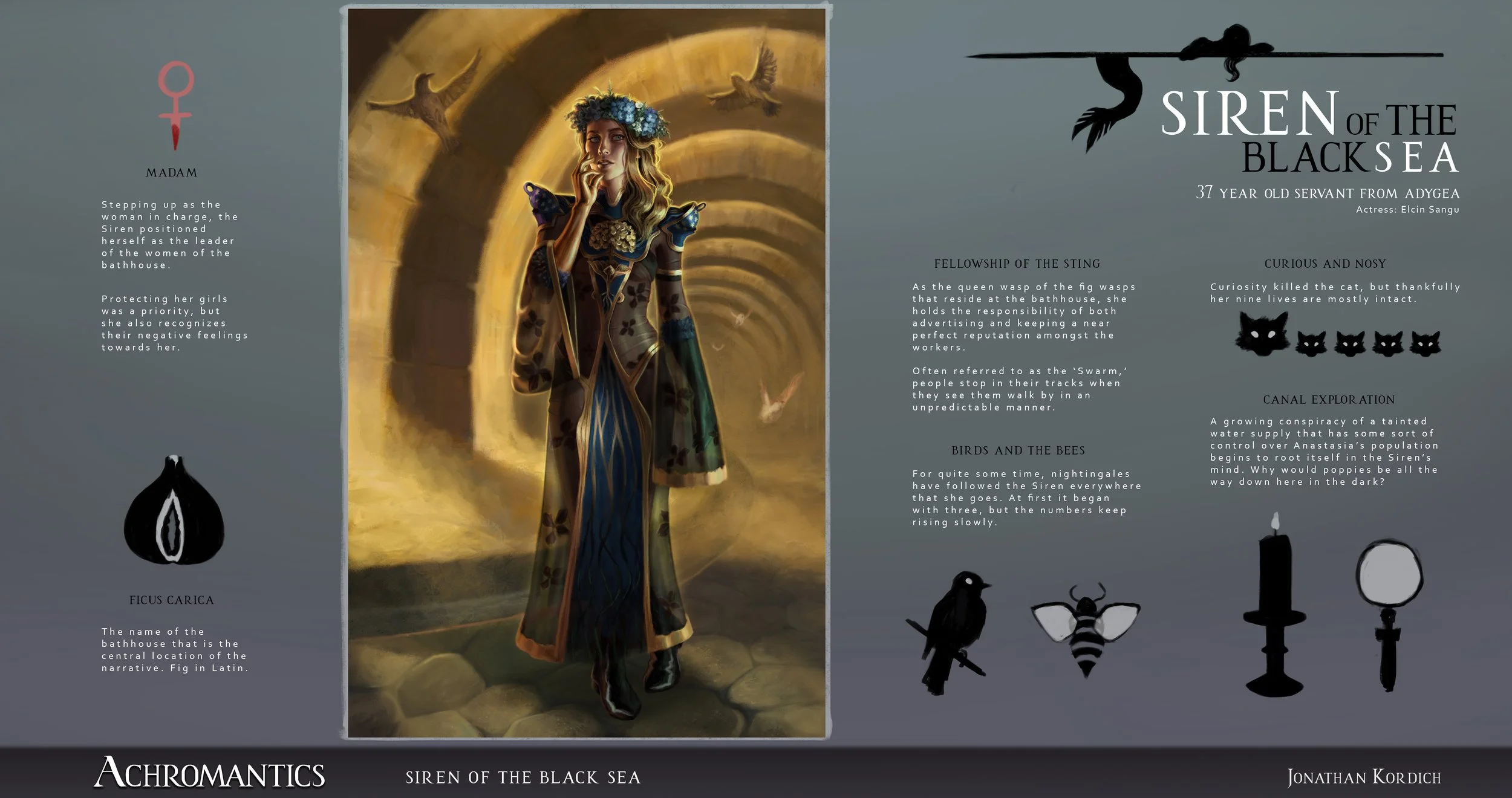
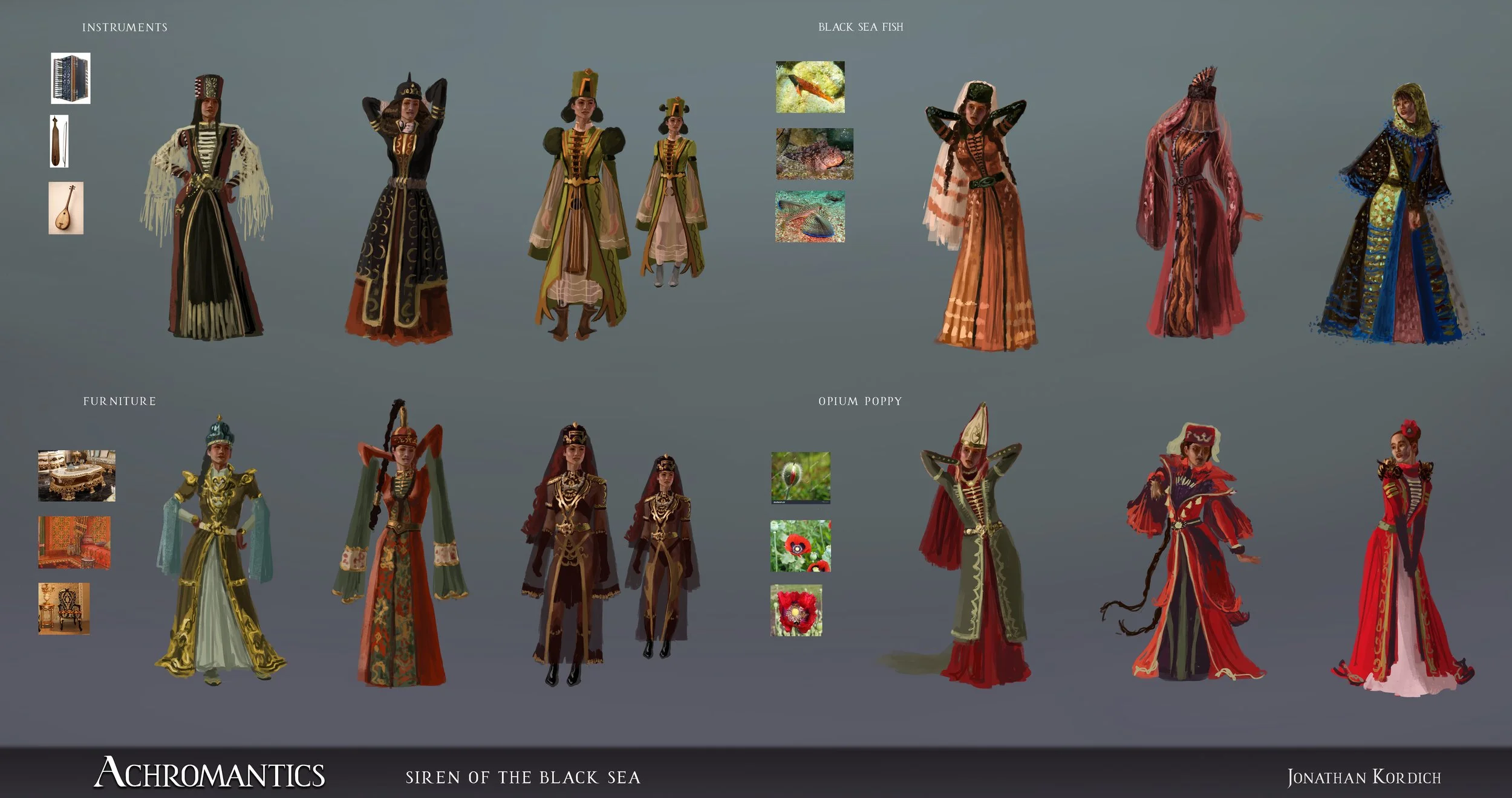
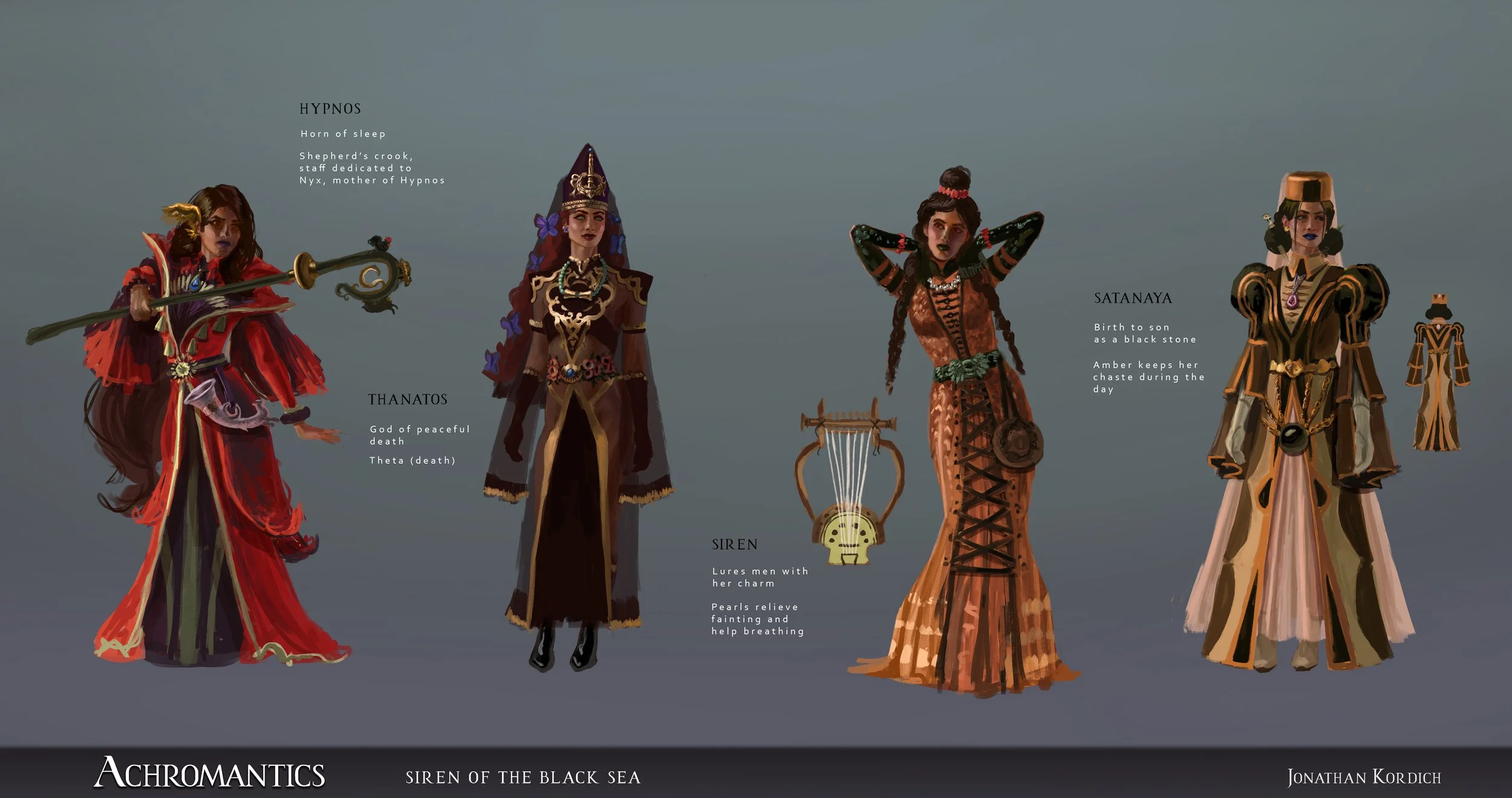
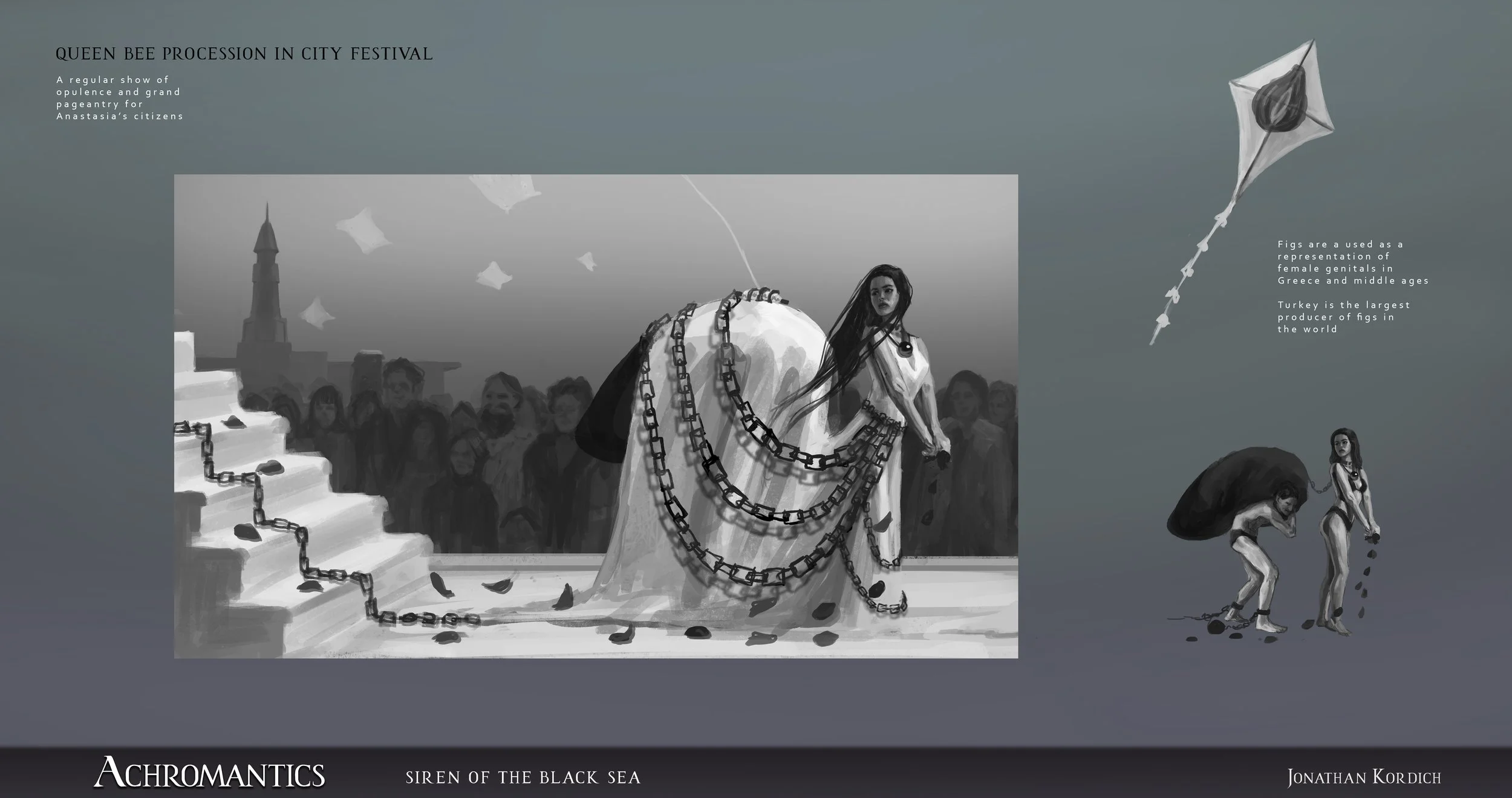
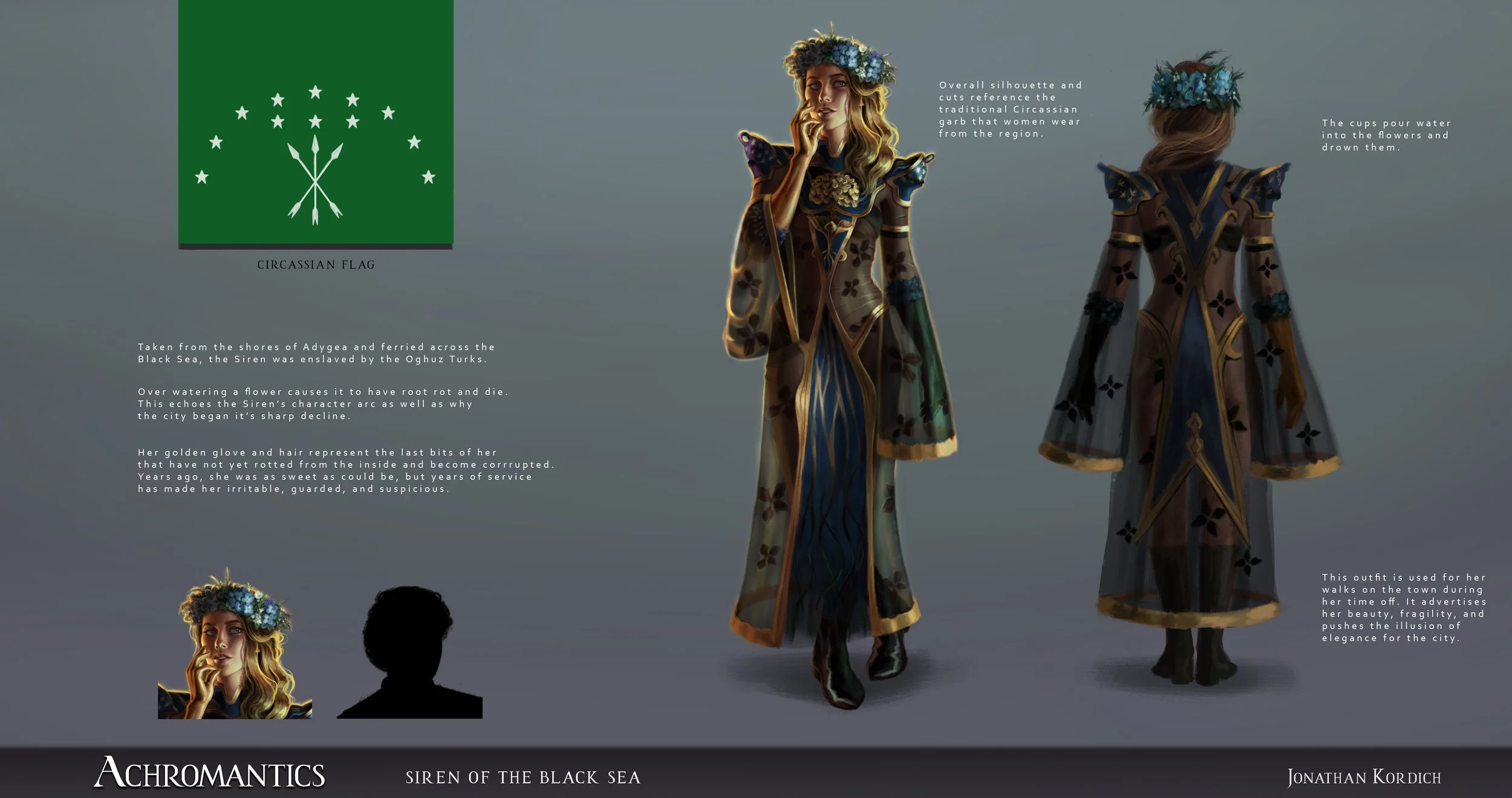
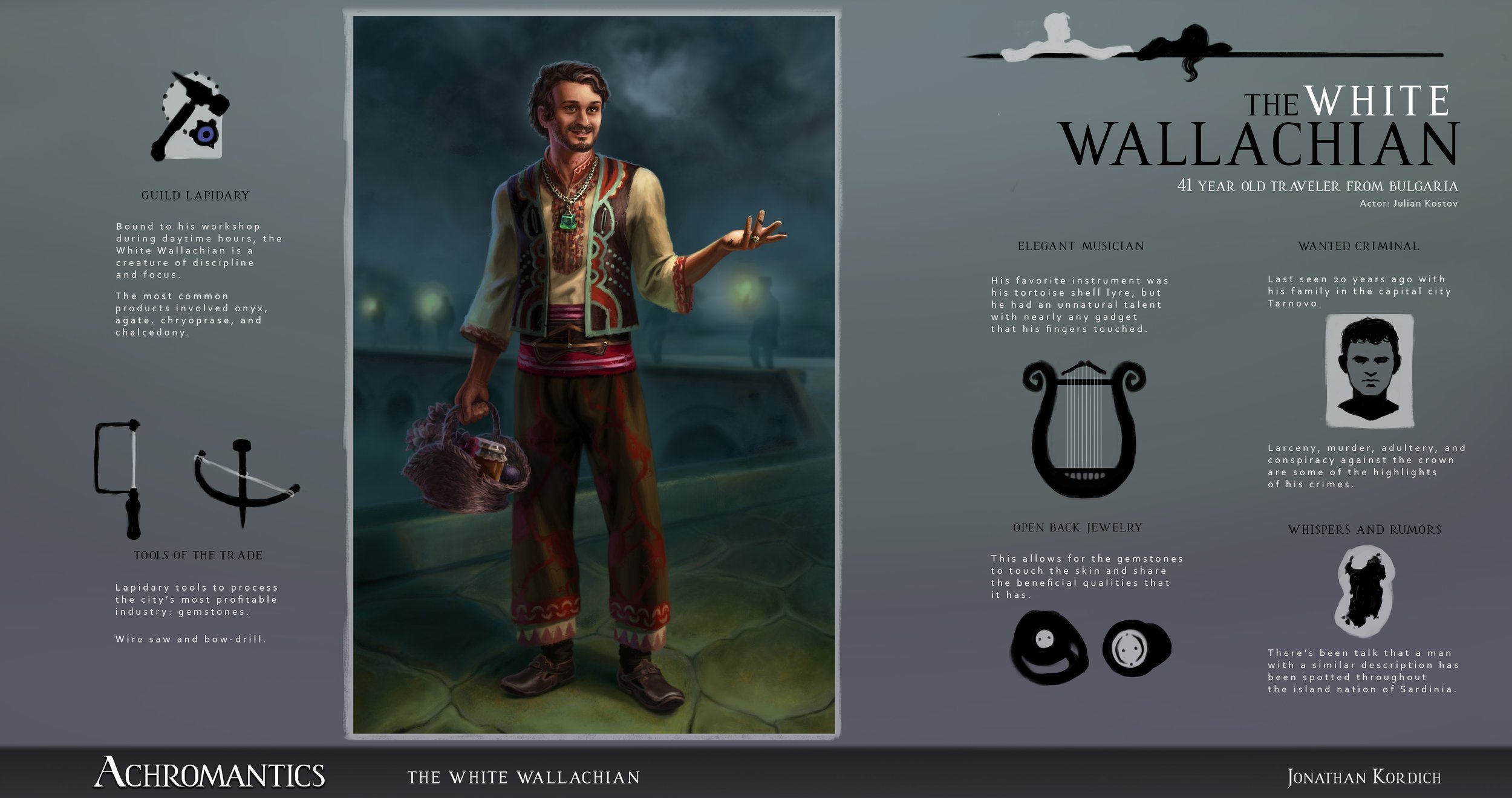
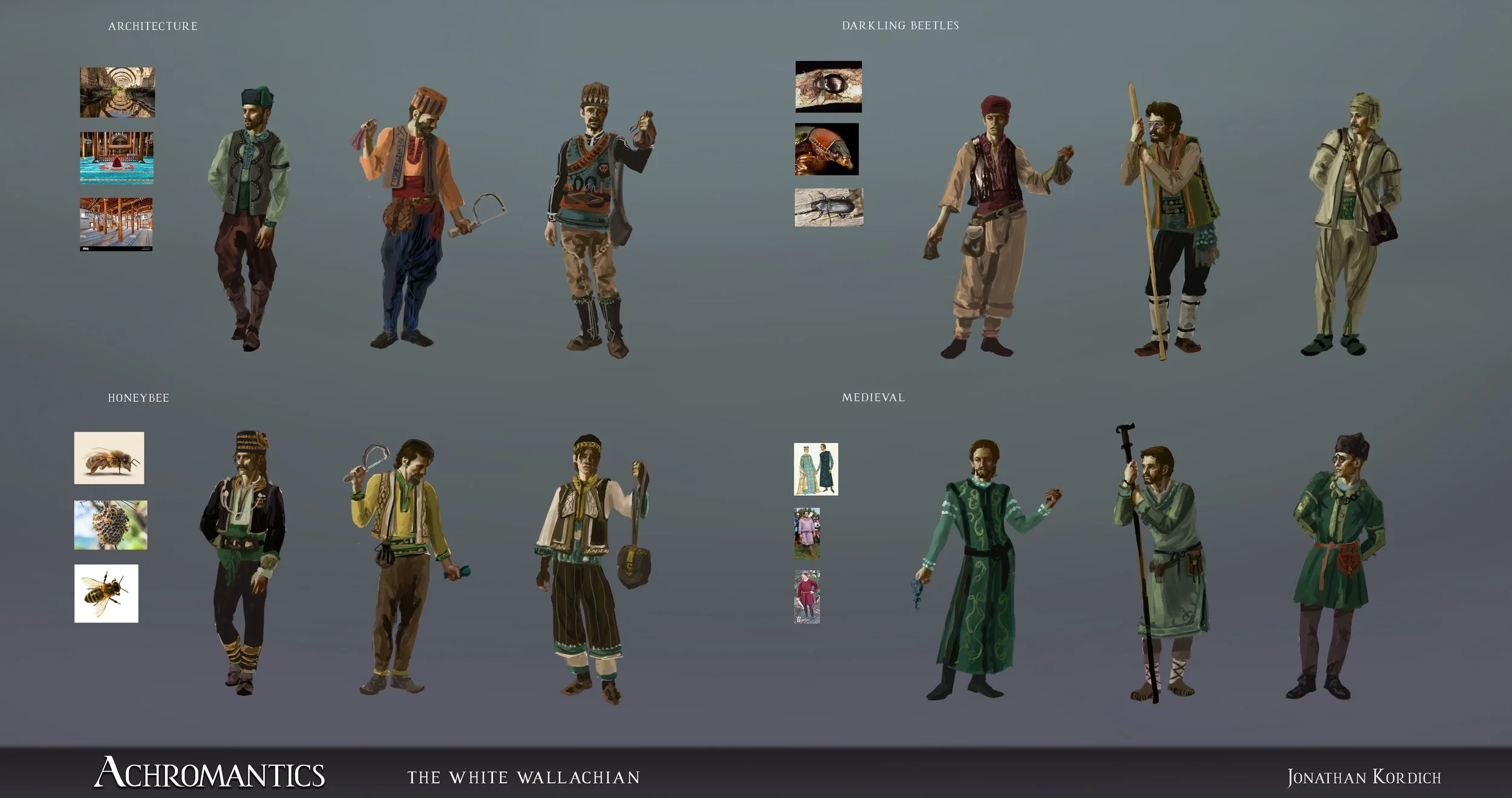
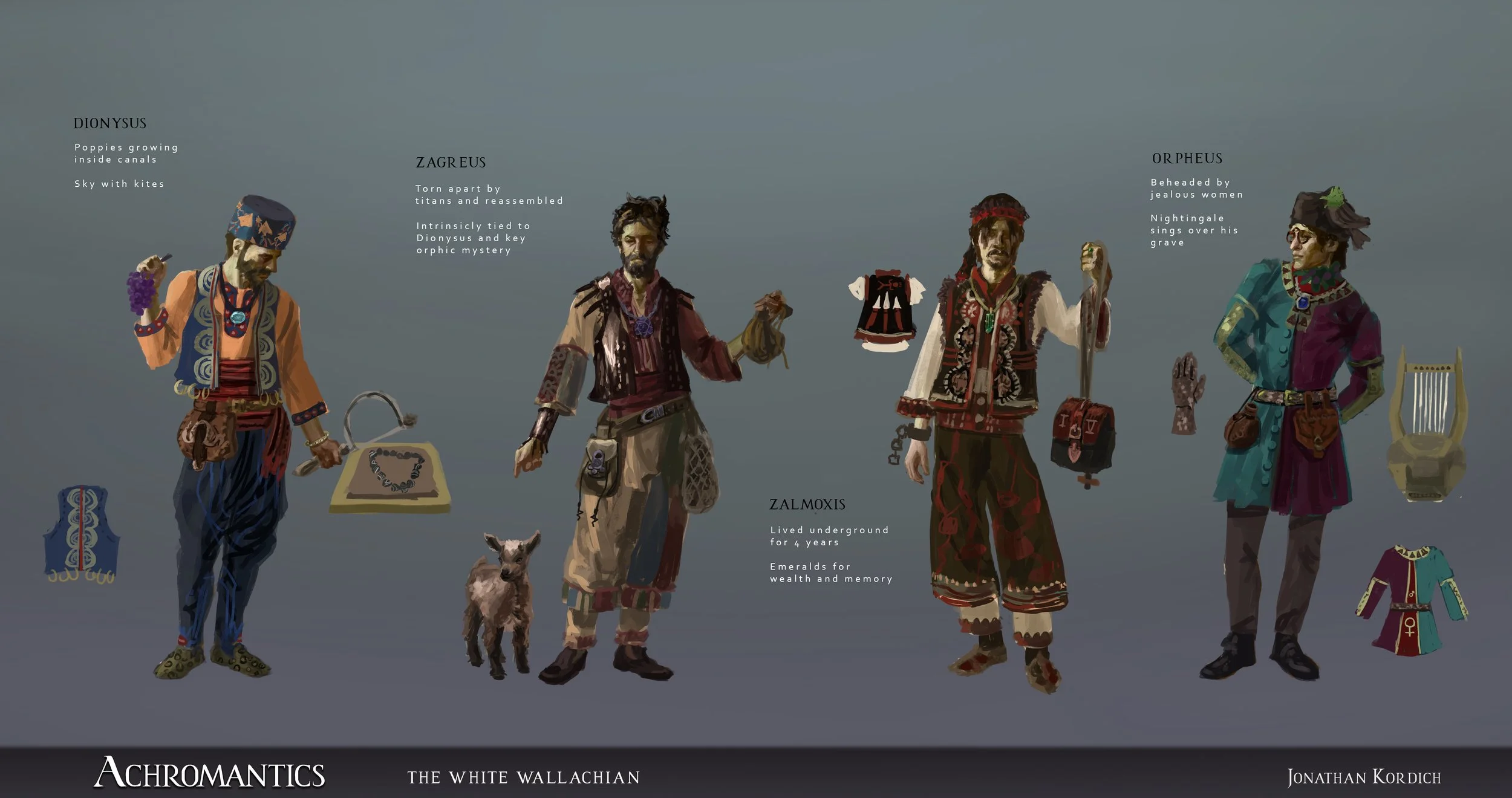
The fictional city of Anastasia from Italo Calvino’s Invisible Cities inspired me to create a narrative/world based on it. Set in 13th century Beypazari (formerly Anastasiopolis), the story follows two primary characters intertwined in the conspiracy of what keeps the people living in Anastasia complacent enough to never leave.
“At the end of three days, moving southward, you come upon Anastasia, a city with concentric canals watering it and kites flying over it. I should now list the wares that can profitably be bought here: agate, onyx, chrysoprase, and other varieties of chalcedony; I should praise the flesh of the golden pheasant cooked here over fires of seasoned cherry wood and sprinkled with much sweet marjoram; and tell of the women I have seen bathing in the pool of a garden and who sometimes — it is said — invite the stranger to disrobe with them and chase them in the water. But with all this, I would not be telling you the city's true essence; for while the description of Anastasia awakens desires one at a time only to force you to stifle them, when you are in the heart of Anastasia one morning your desires waken all at once and surround you. The city appears to you as a whole where no desire is lost and of which you are a part, and since it enjoys everything you do not enjoy, you can do nothing but inhabit this desire and be content. Such is the power, sometimes called malignant, sometimes benign, that Anastasia, the treacherous city, possesses; if for eight hours a day you work as a cutter of agate, onyx, chrysoprase, your labor which gives form to desire takes from desire its form, and you believe you are enjoying Anastasia wholly when you are only its slave.”
-Italo Calvino
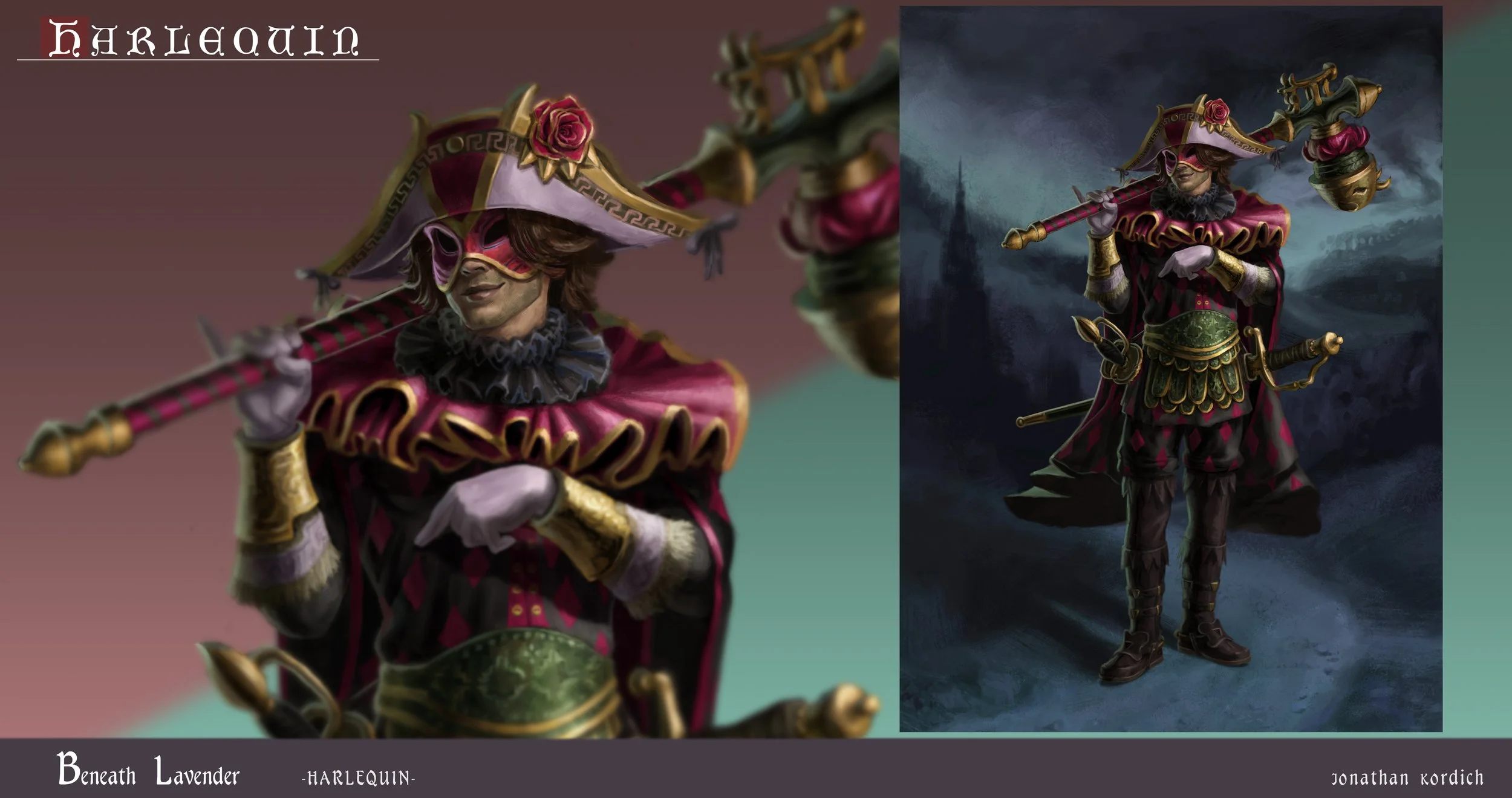
beneath lavender - personal project
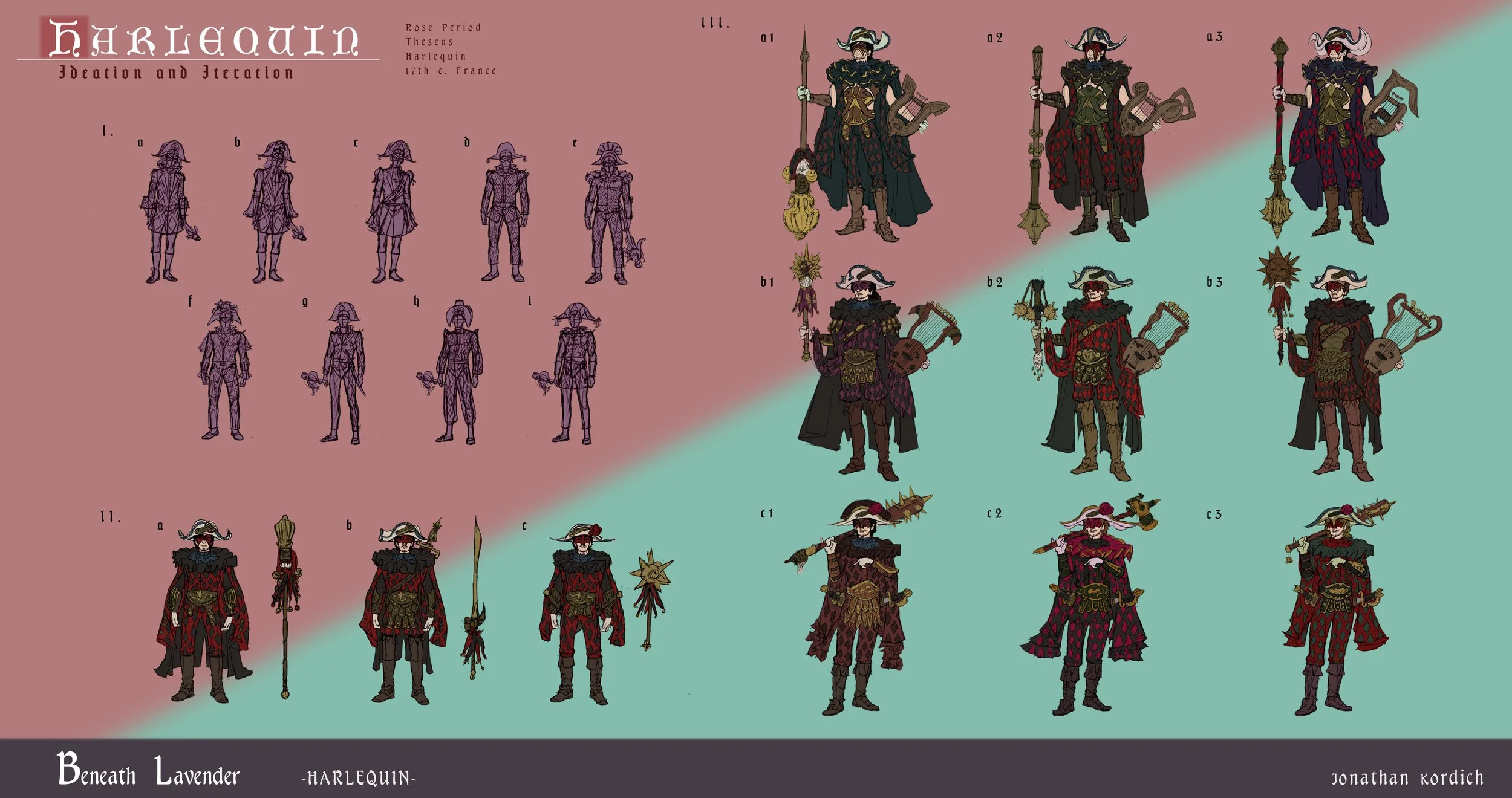
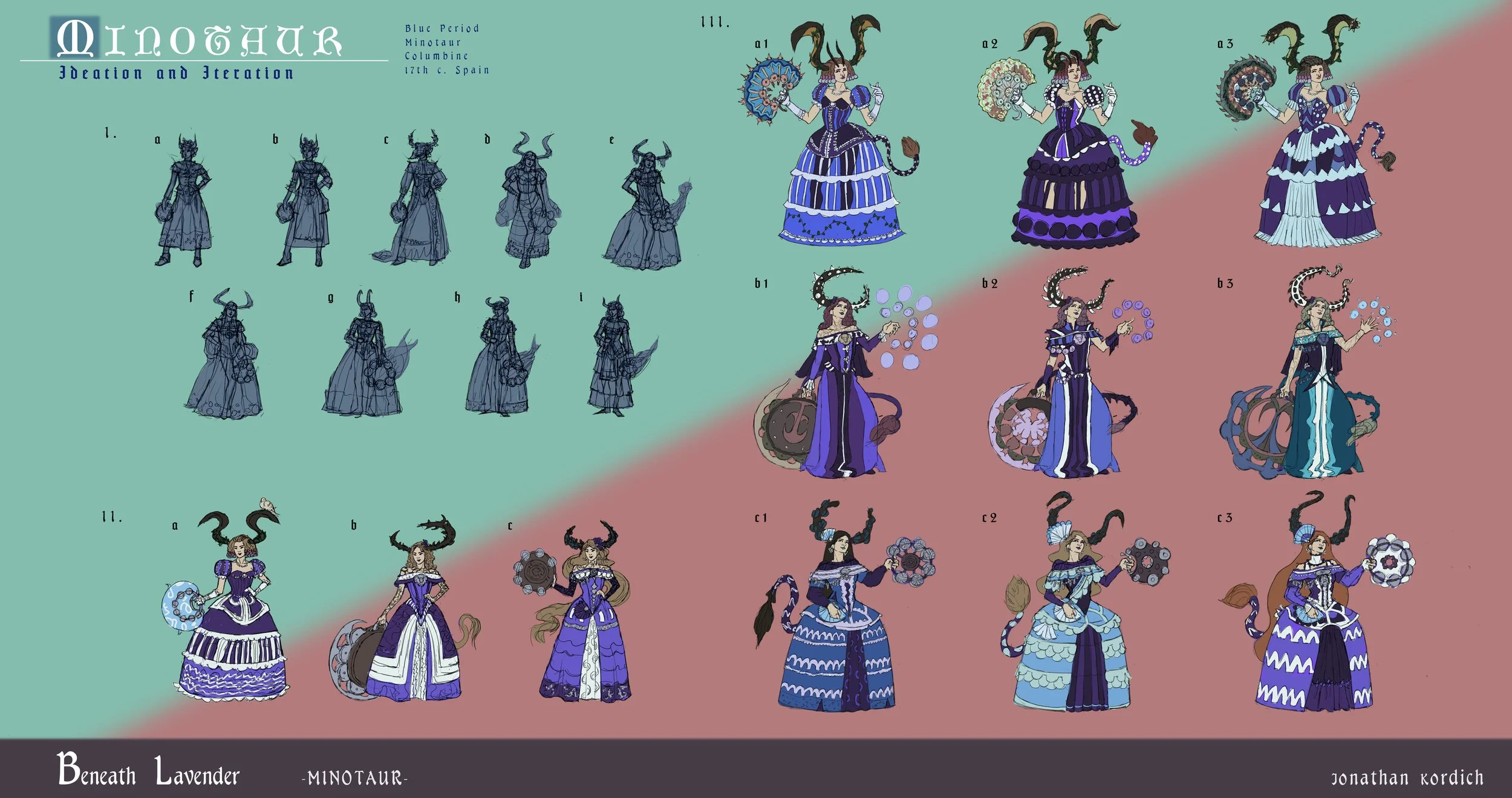
Based on some Pablo Picasso’s favorite motifs in the Rose Period and Blue Period, this is my fantastical take on 17th Century Spain.
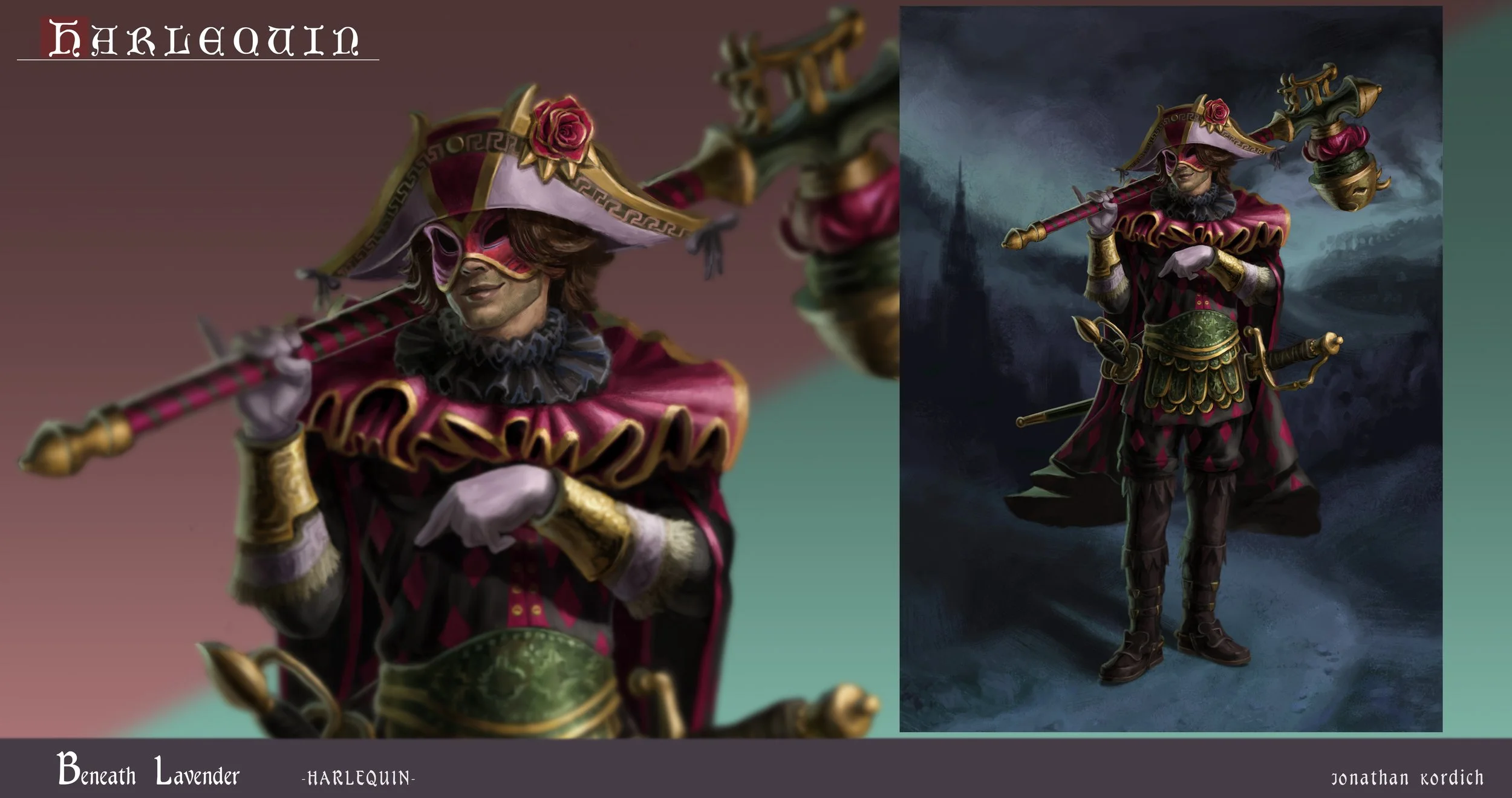
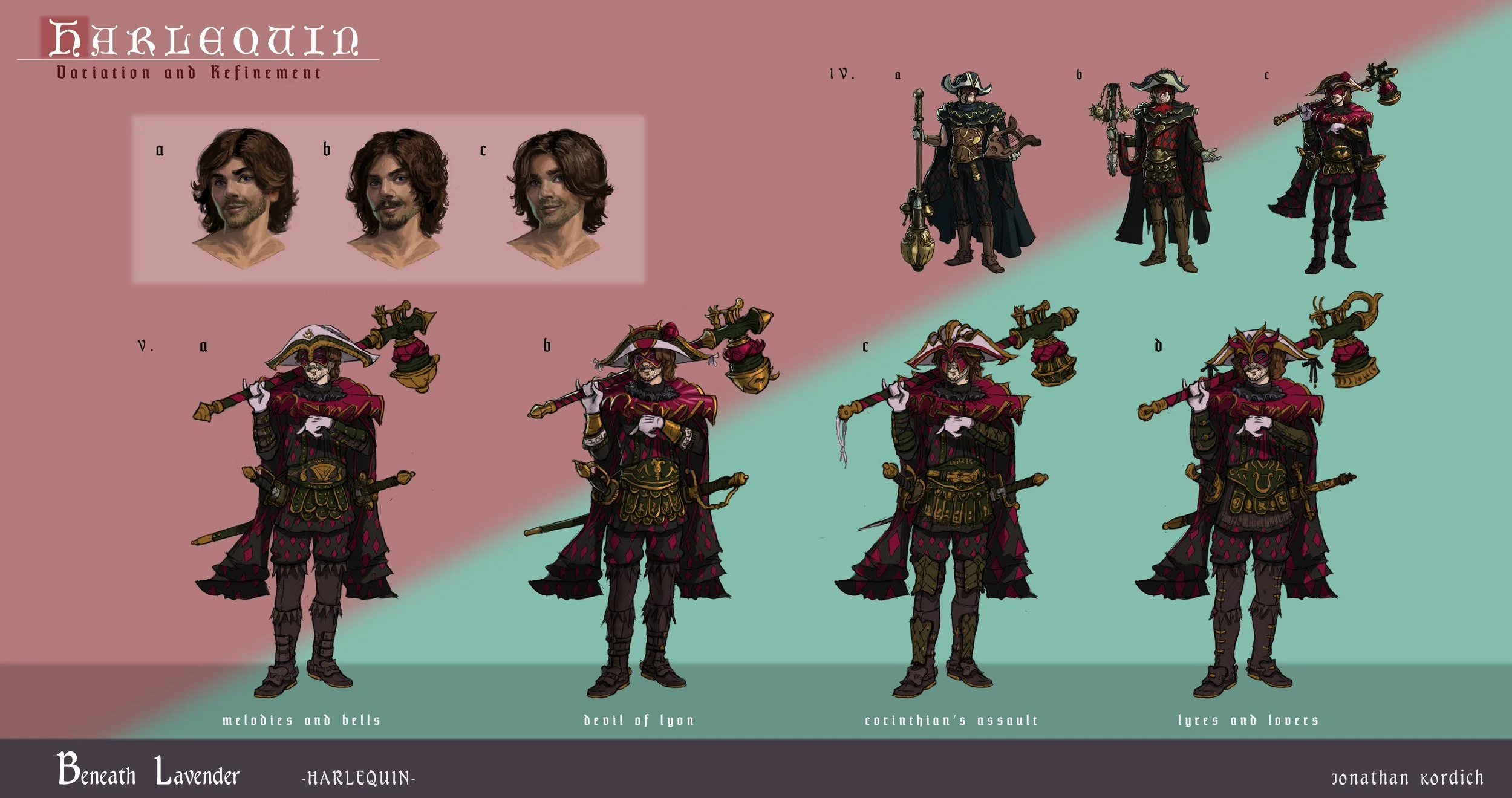
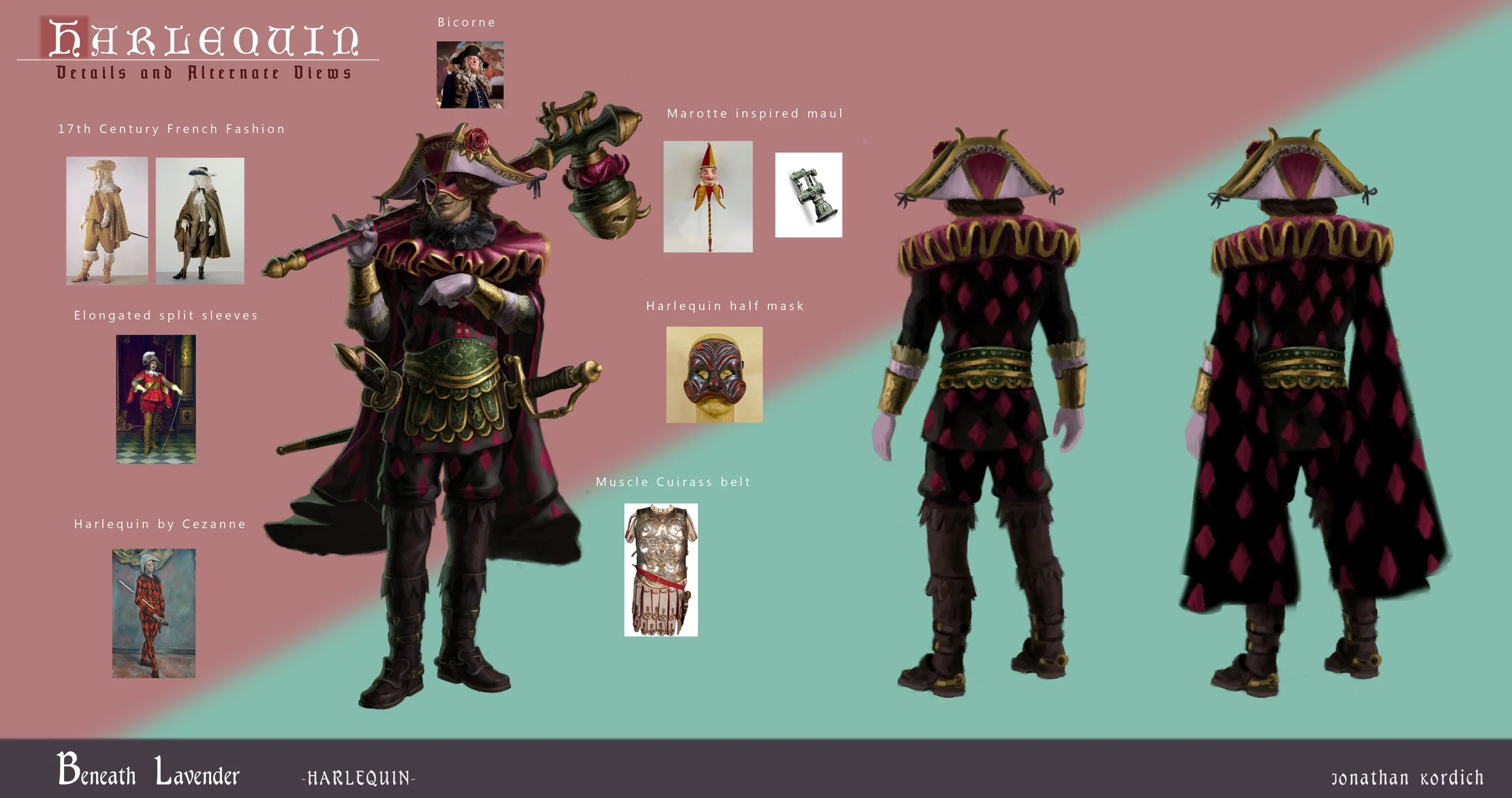
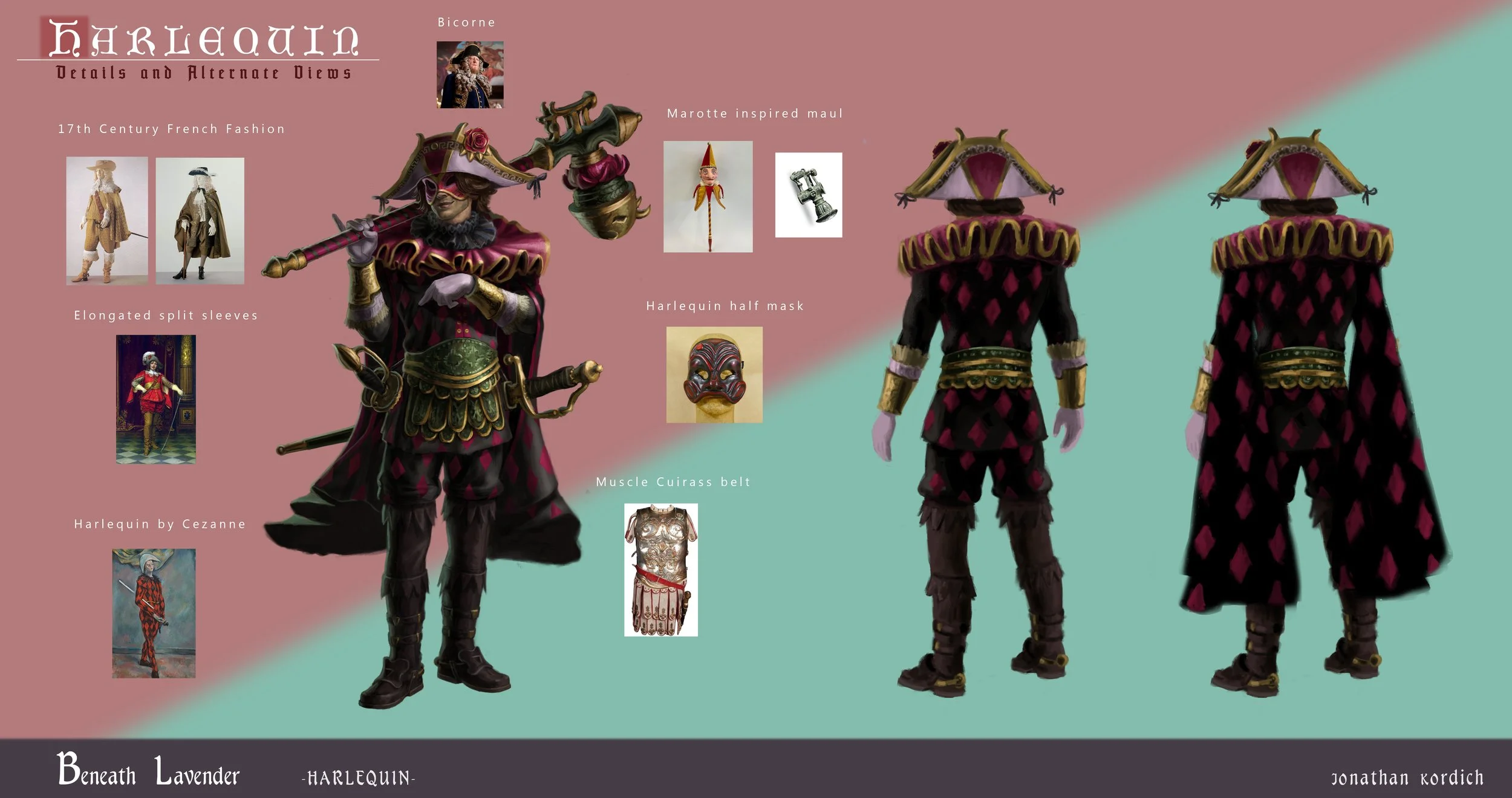
With the Harlequin being the primary motif of the Rose Period, I drew inspiration from the Commedia dell'arte stock character. To contrast his opposite, the Minotaur, I also combined the divine hero Theseus. For Harlequin, I made him mostly grounded in 17th Century France (The Red World.)
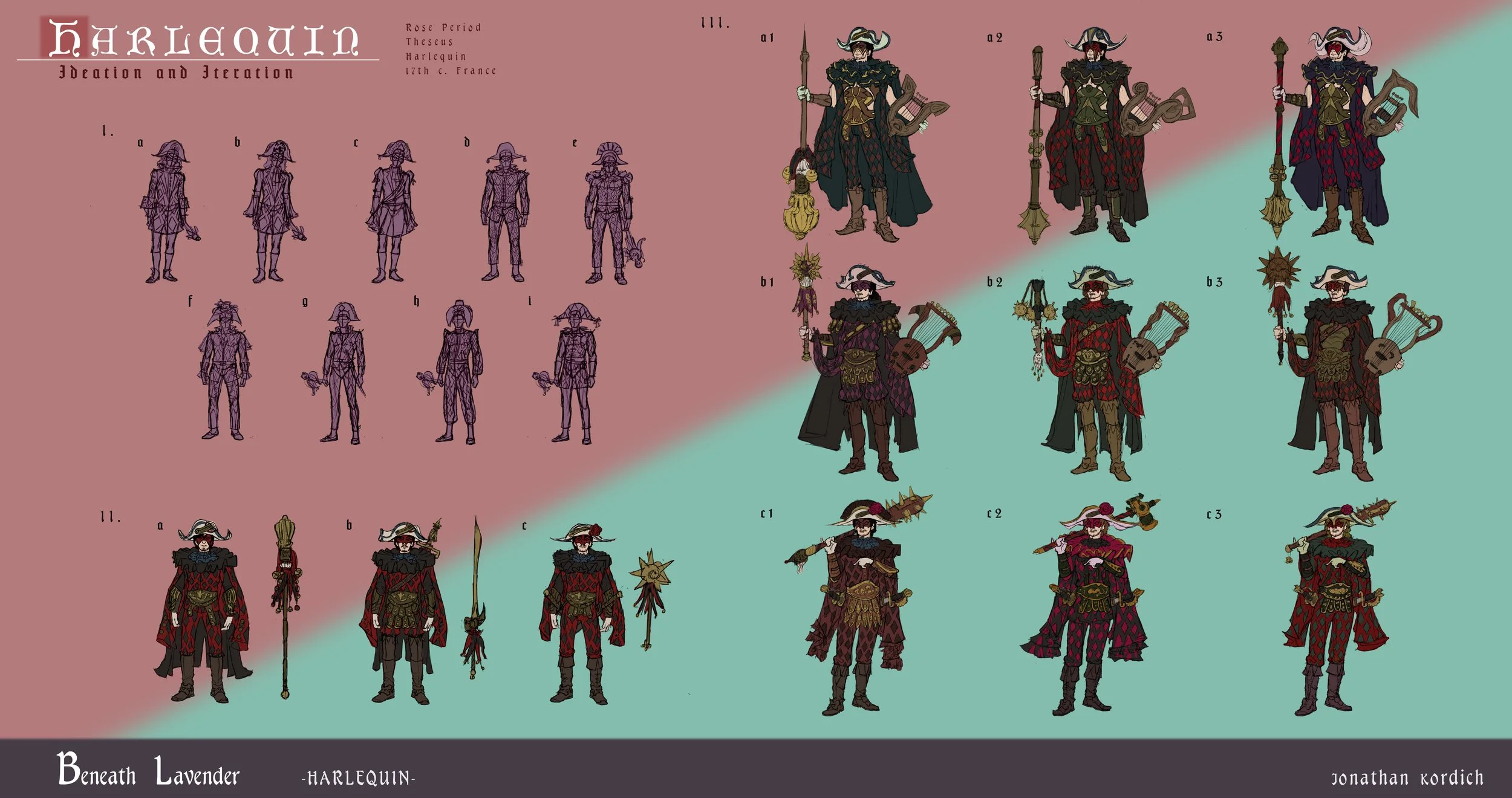
The name Harlequin is based on mischievous devil that went around with a club. Playing with the idea of a two handed club vs. a morning star was first plan of attack. I knew that the bicorne, Greek belt, and large neck ruffle would be in every design. I also played with the idea of him having Theseus’ harp.
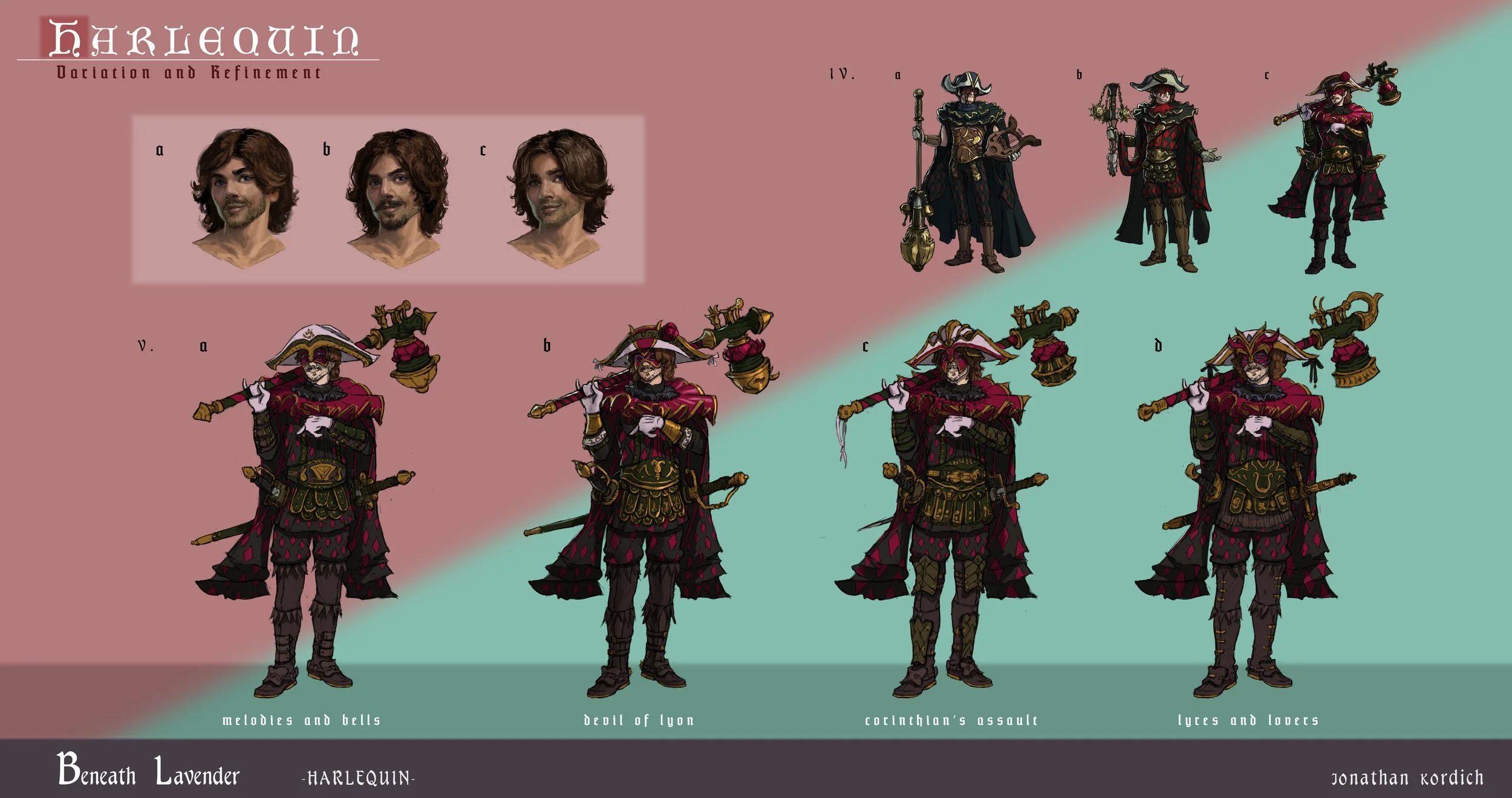
For the Harlequin’s attitude, I pulled from Sanjuro. When designing the hat, I tried combining elements of the Corinthian helmet with the bicorne.
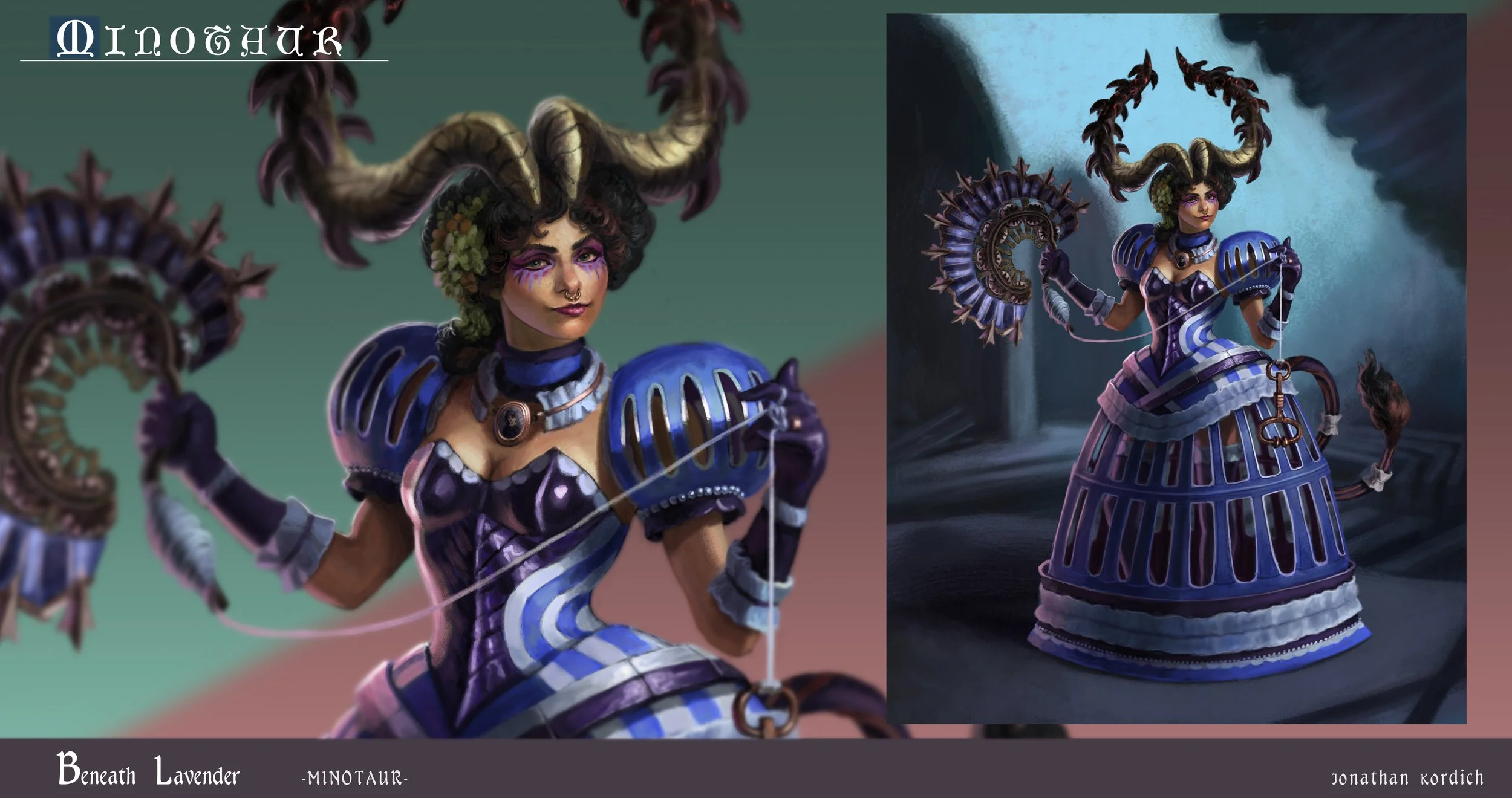
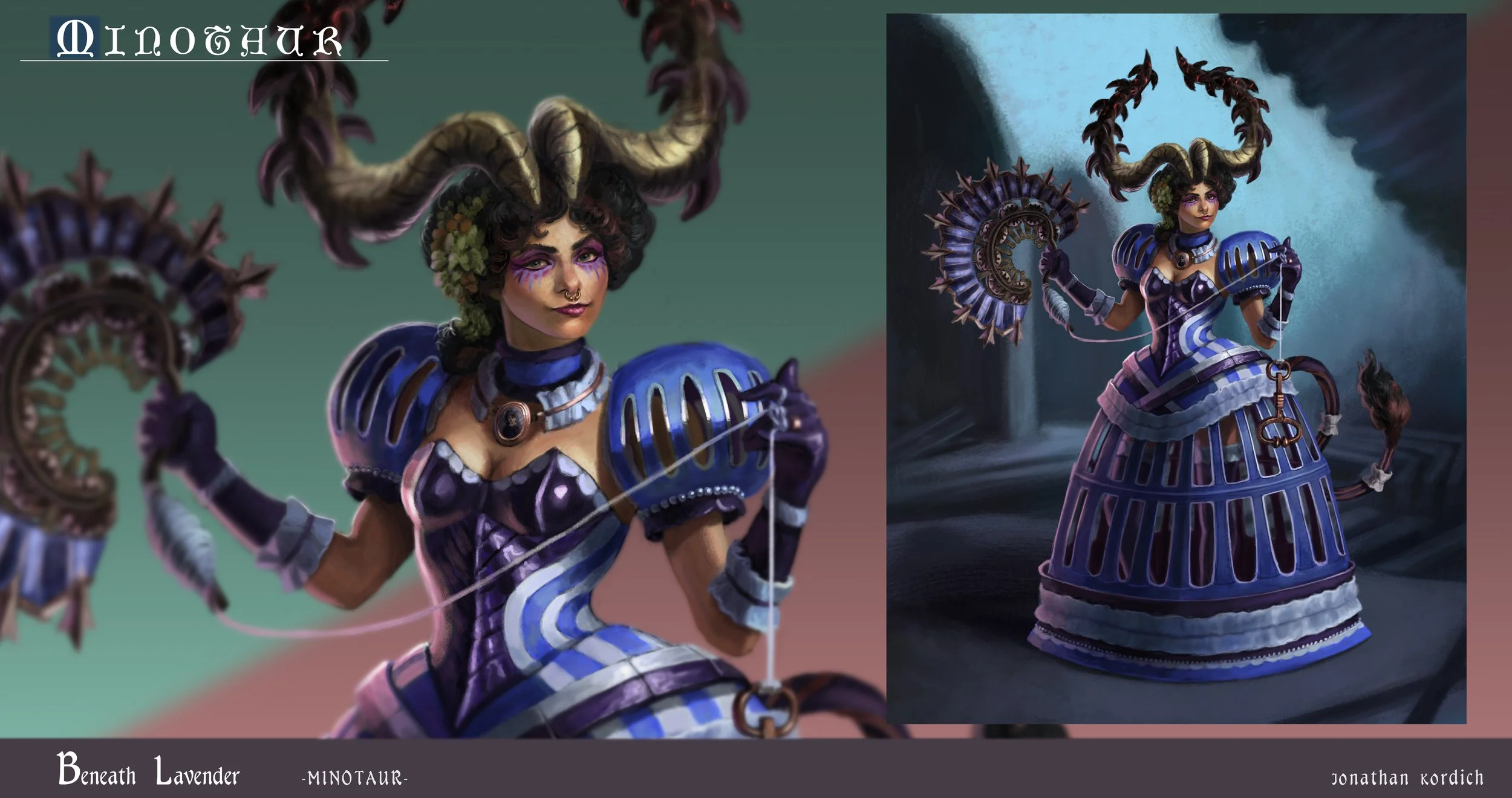
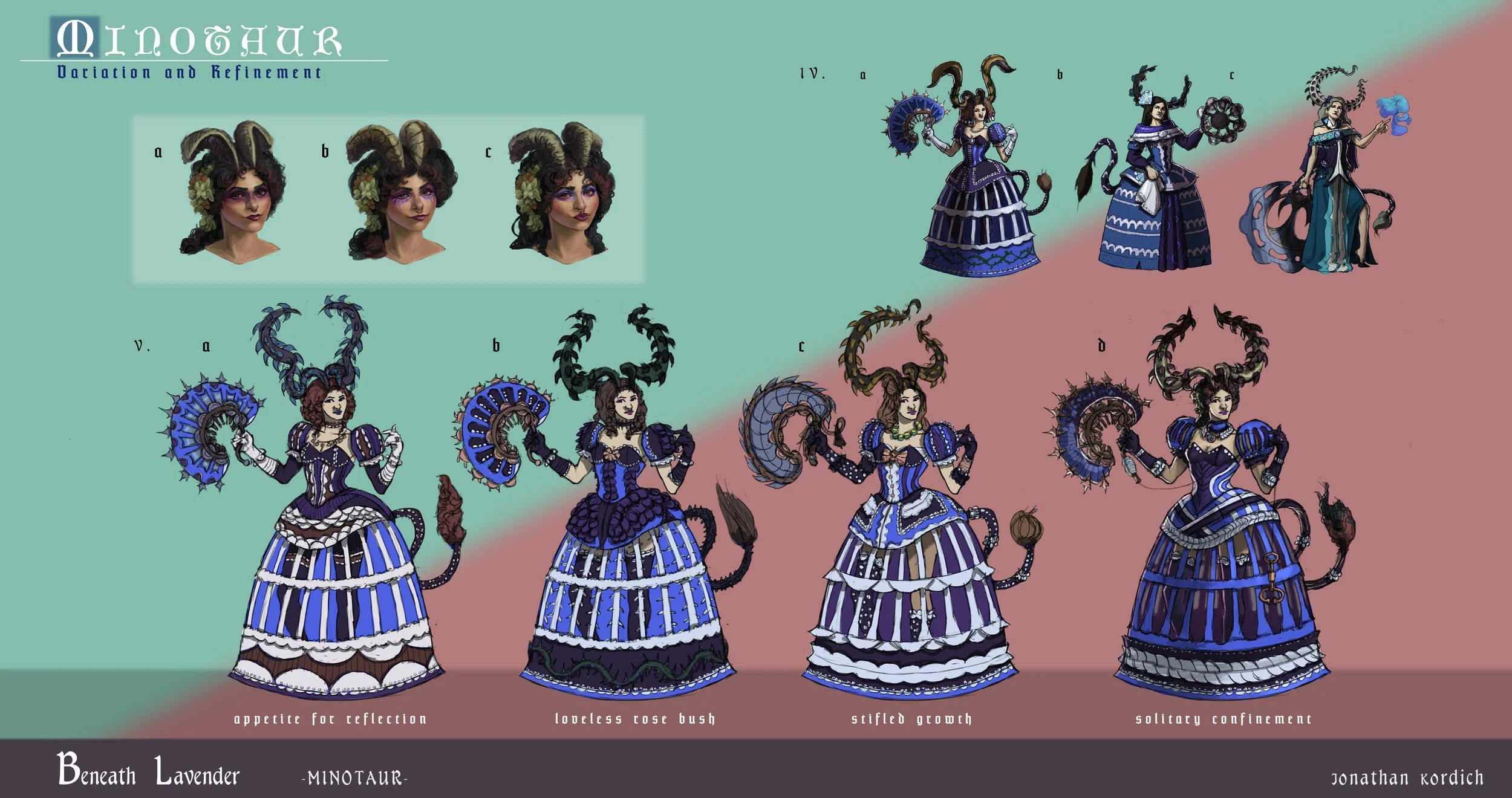
The primary motif in the Blue Period was the Minotaur. Playing with the idea of a human hybrid raised and abused like actual cattle, I wanted the Minotaur to be committed to an arc of revenge in 17th Century Spain (The Blue World.) To contrast against the Harlequin character, I gave the Minotaur the characteristics of the Columbine stock character.
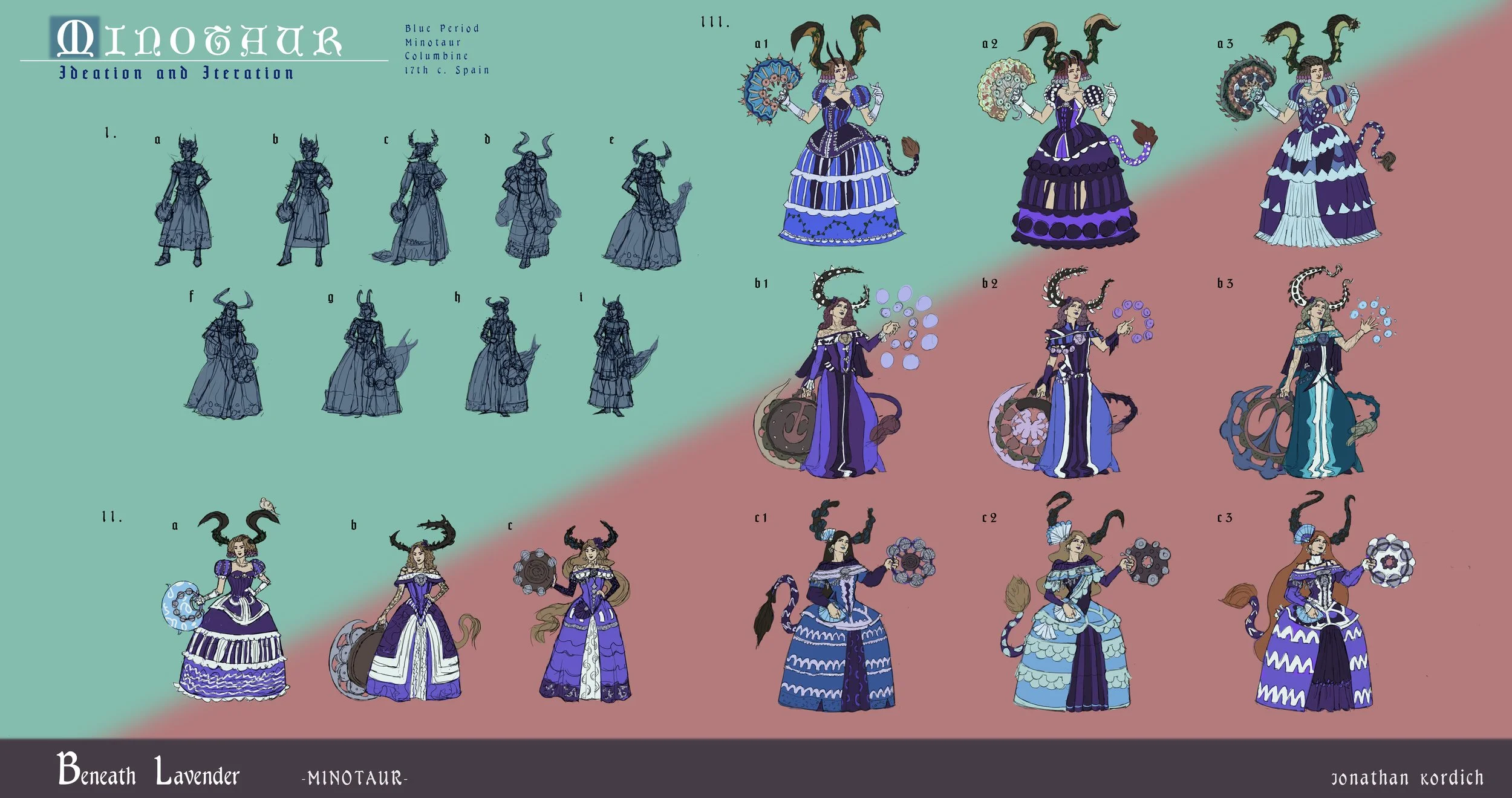
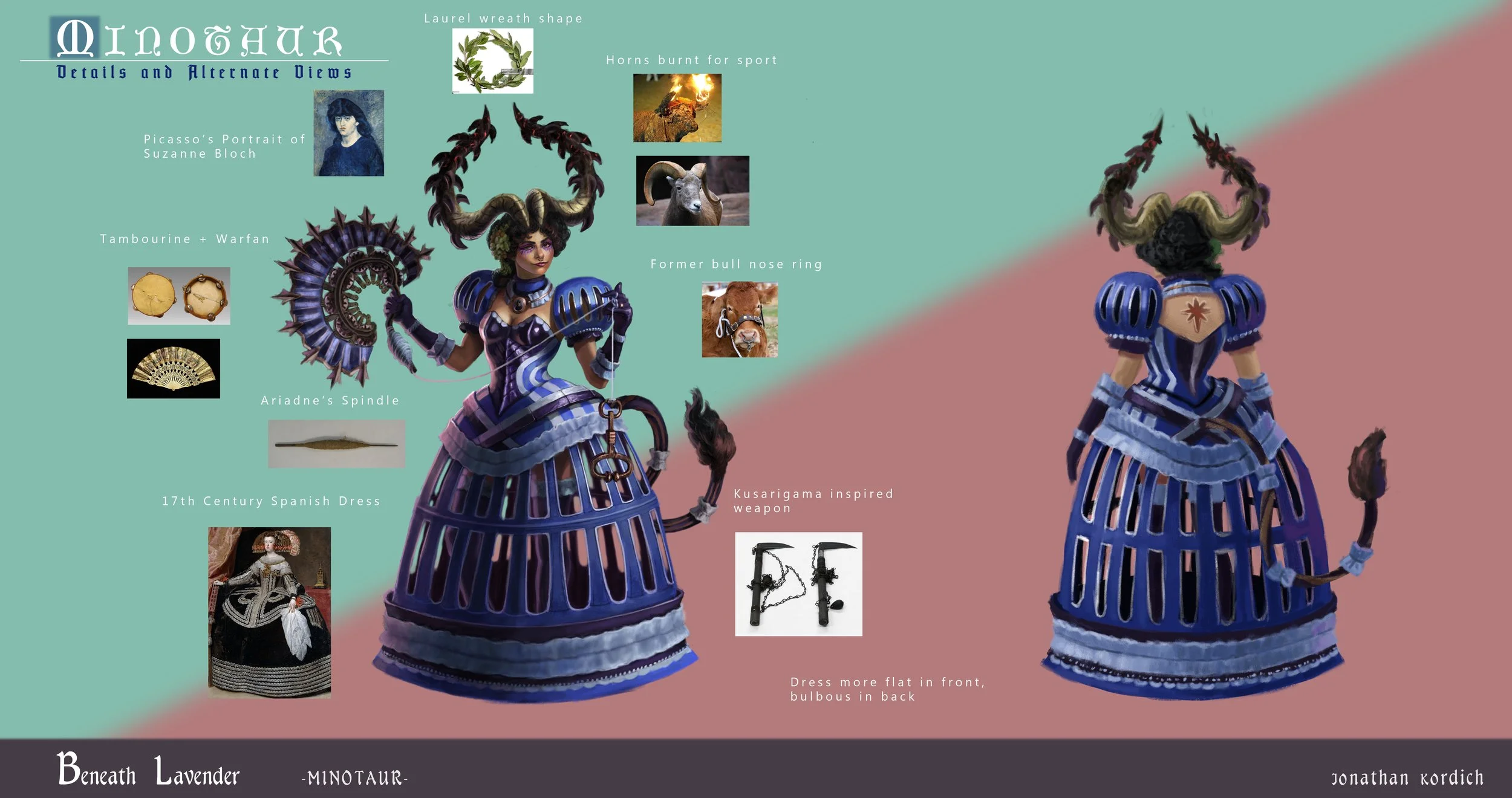
A hallmark of the Columbine is a dancer with a tambourine. Scaling up the tambourine and combining it with a warfan were my weapon ideations. I knew that the human hybrid aspects were going to involve large bull horns and a tail.
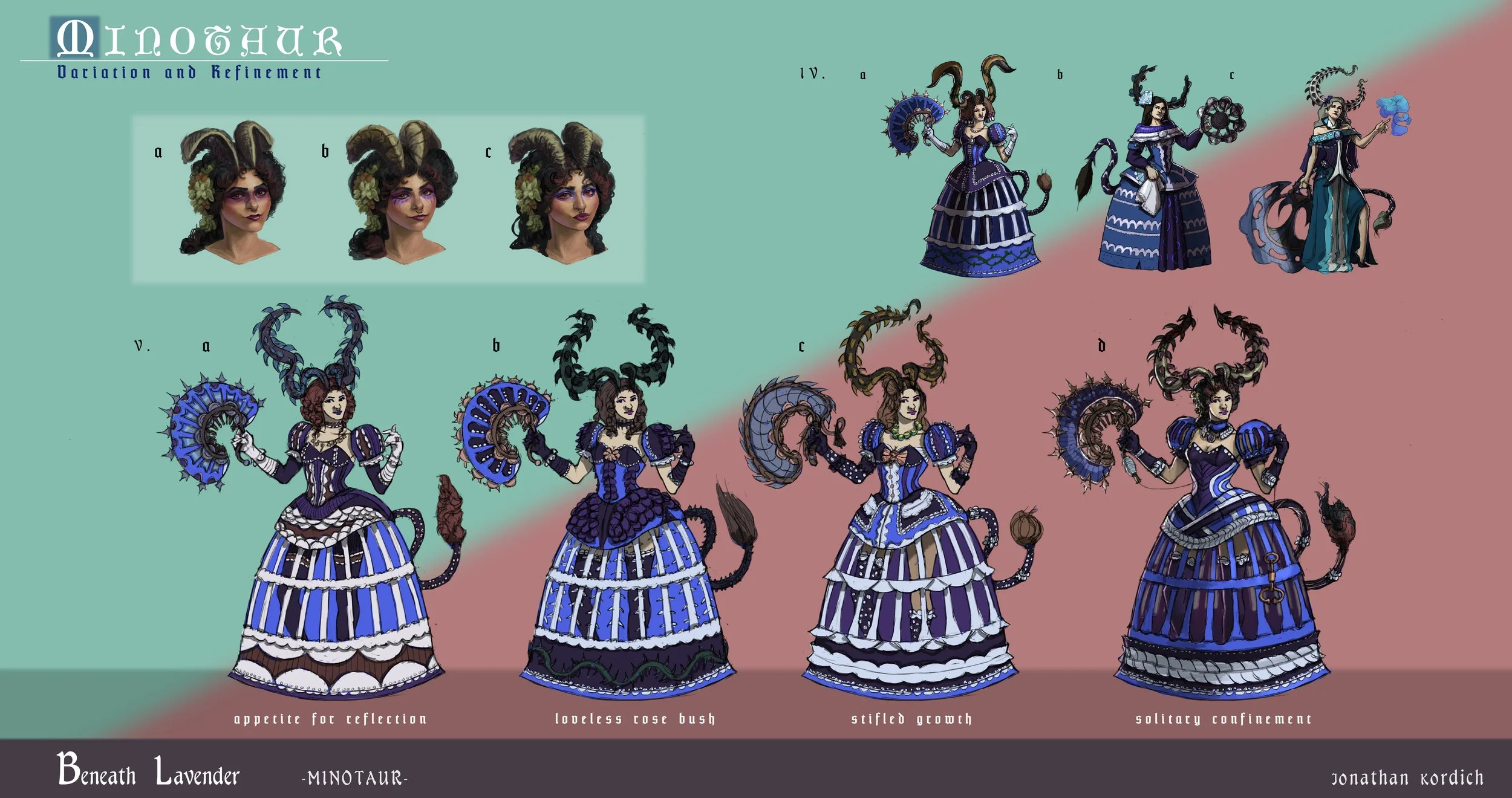
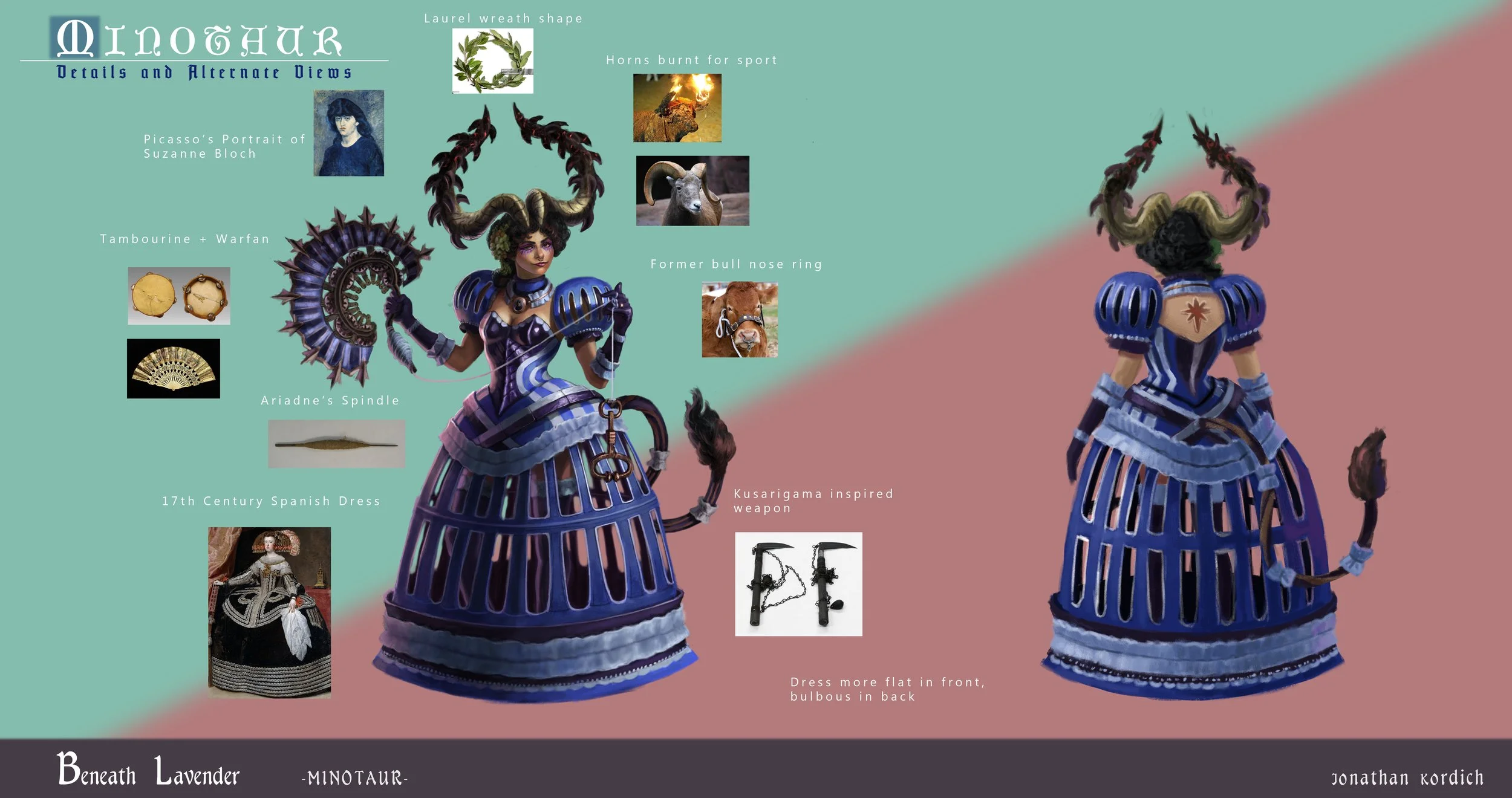
For the final iterations/variations, I decided to go with the cage dress. Similar to her upbringing, she was like a caged animal, and wanted to represent that in her outfit. The warfan-tambourine that I created was also dual purposed into a Kusarigama. The weighted end is the bull nose ring device that was used on her to tame/train her.
Diablo - personal project
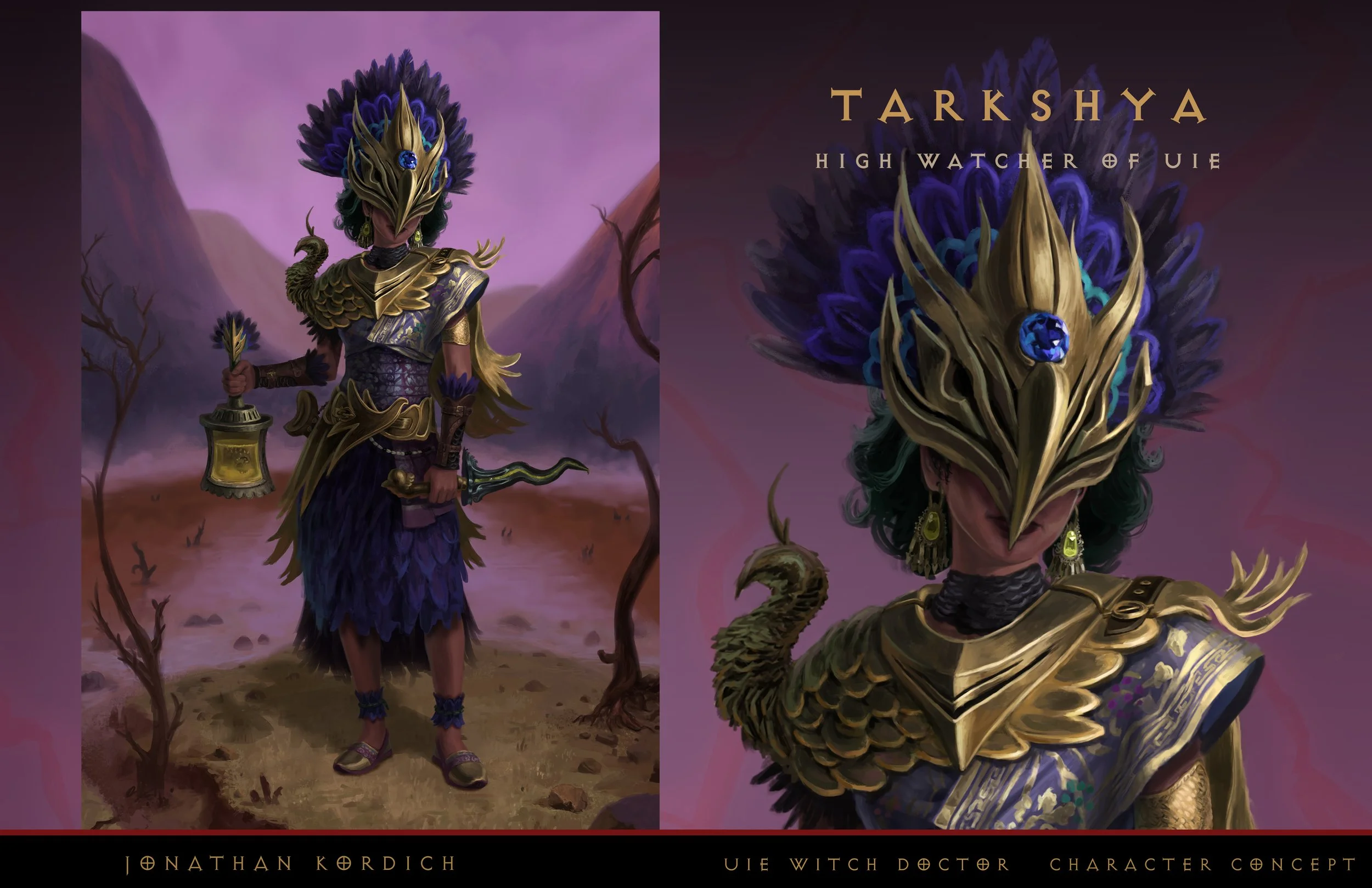
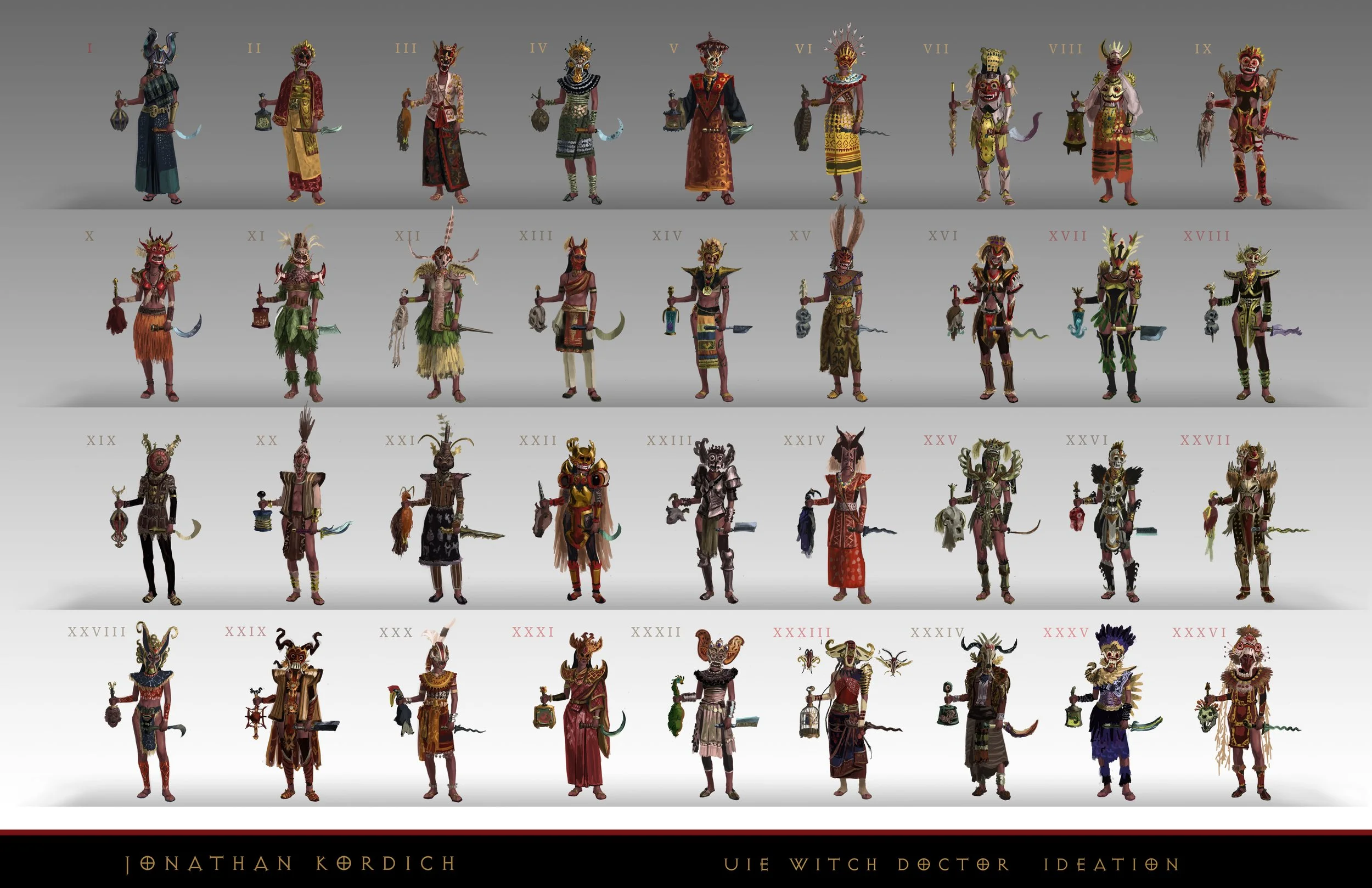
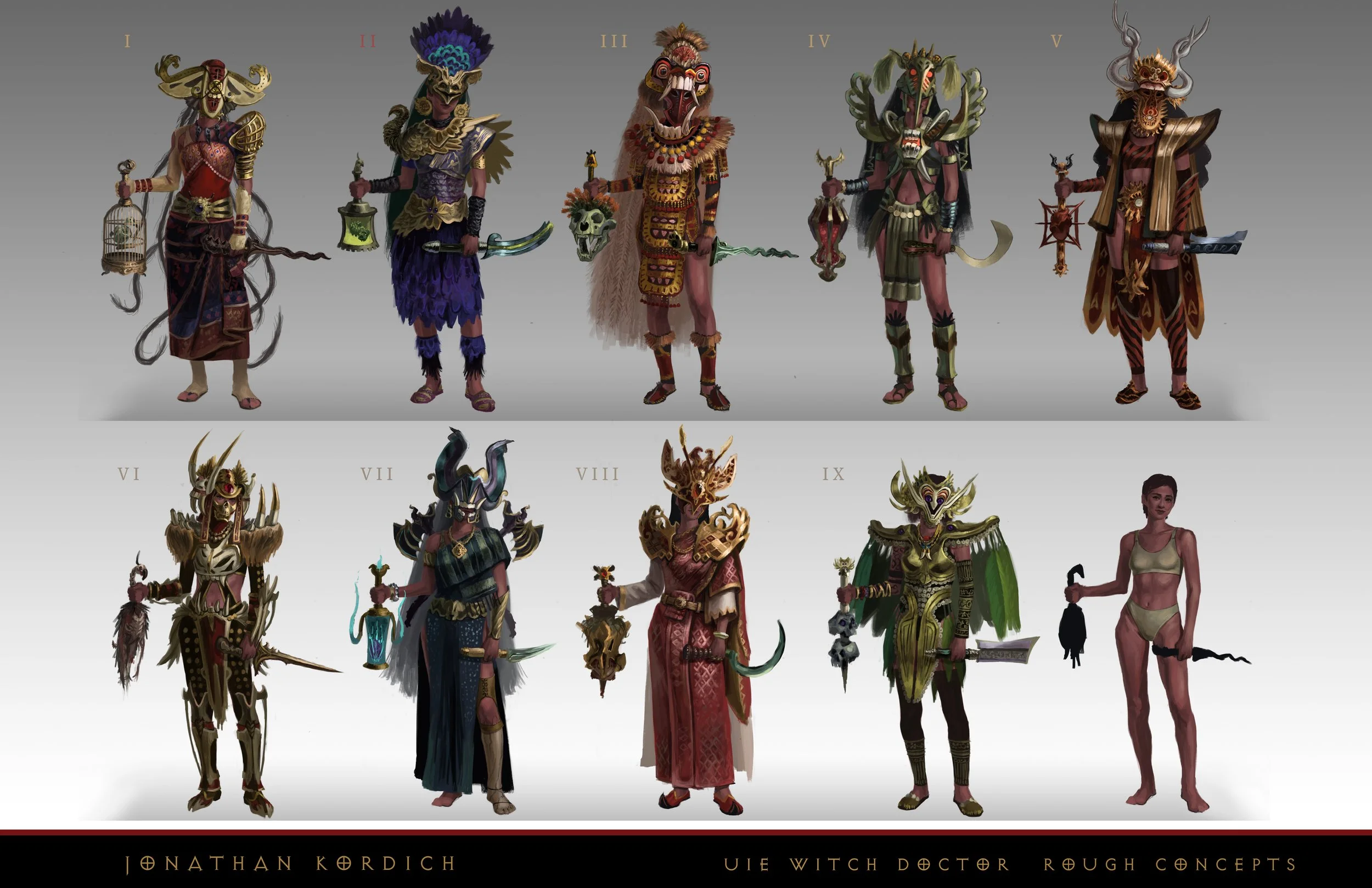
This is my take on what a Witch Doctor would look like in Diablo 4. Using the island nation of Uie, a currently unexplored location in the canon, I wanted to interpret what a Witch Doctor would look like when originating from Bali and nearby islands.
Both Animism and Hinduism are prominent in the culture and are featured in the different iterations. I chose different starting points for each design such as with traditional garb, what I expect Diablo aesthetic to look like, from a modern interpretation of the outfits, or with a strong animal motif in mind.
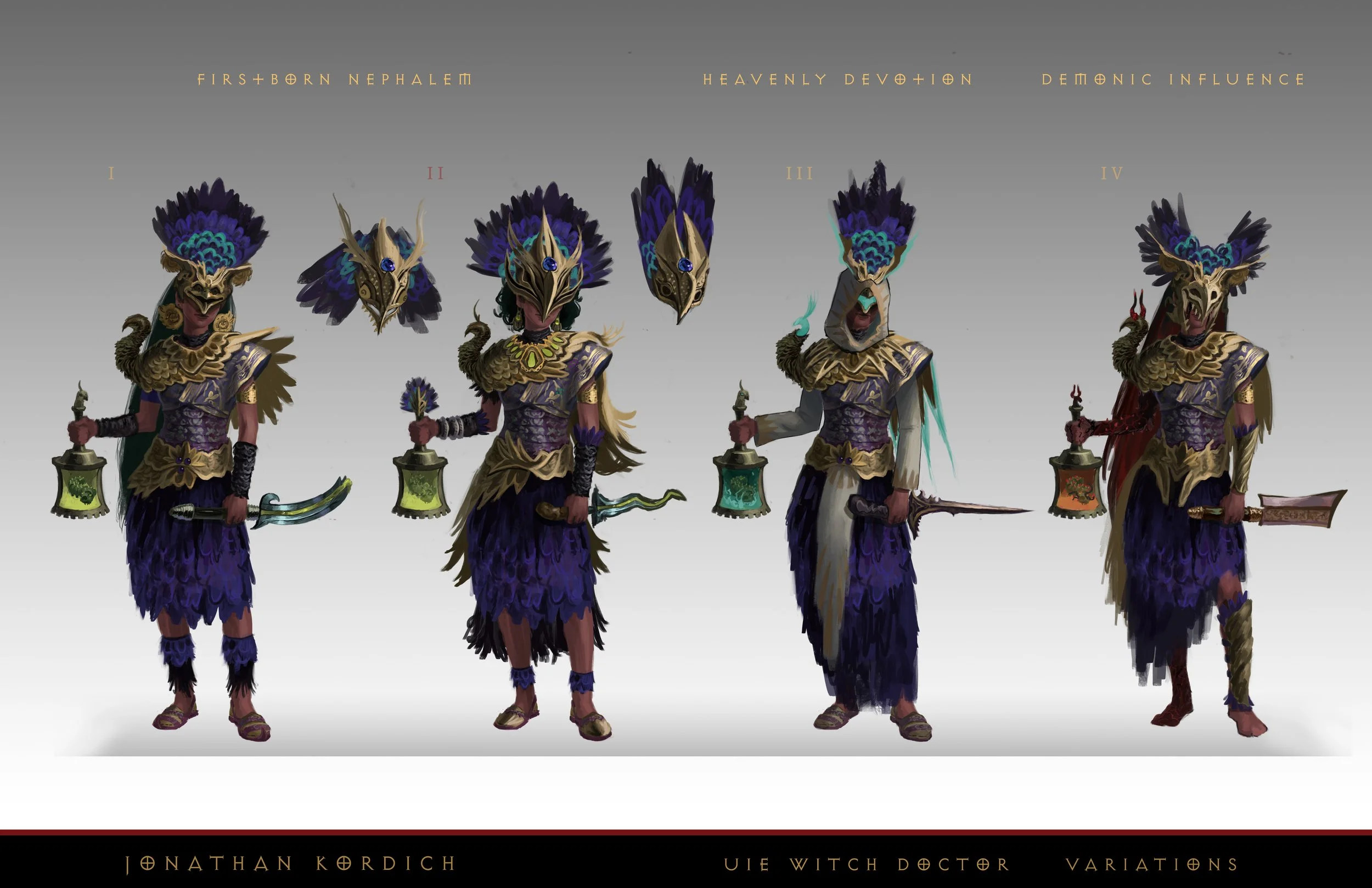
Tarkshya is a Firstborn Nephalem, one of the Ancients in the lore. As a result of living for thousands of years, she would certainly have had many outfits, looks, and overall phases than the average character.
Given the nature of Nephalem being born from Lilith and Inarius, I decided to explore variations of what Tarkshya would look like if she had either the angelic or demonic side take precedence over the other. Myken’s Ball of Hate being from Uie led to me using Mephisto as the main demonic influence of the nation.
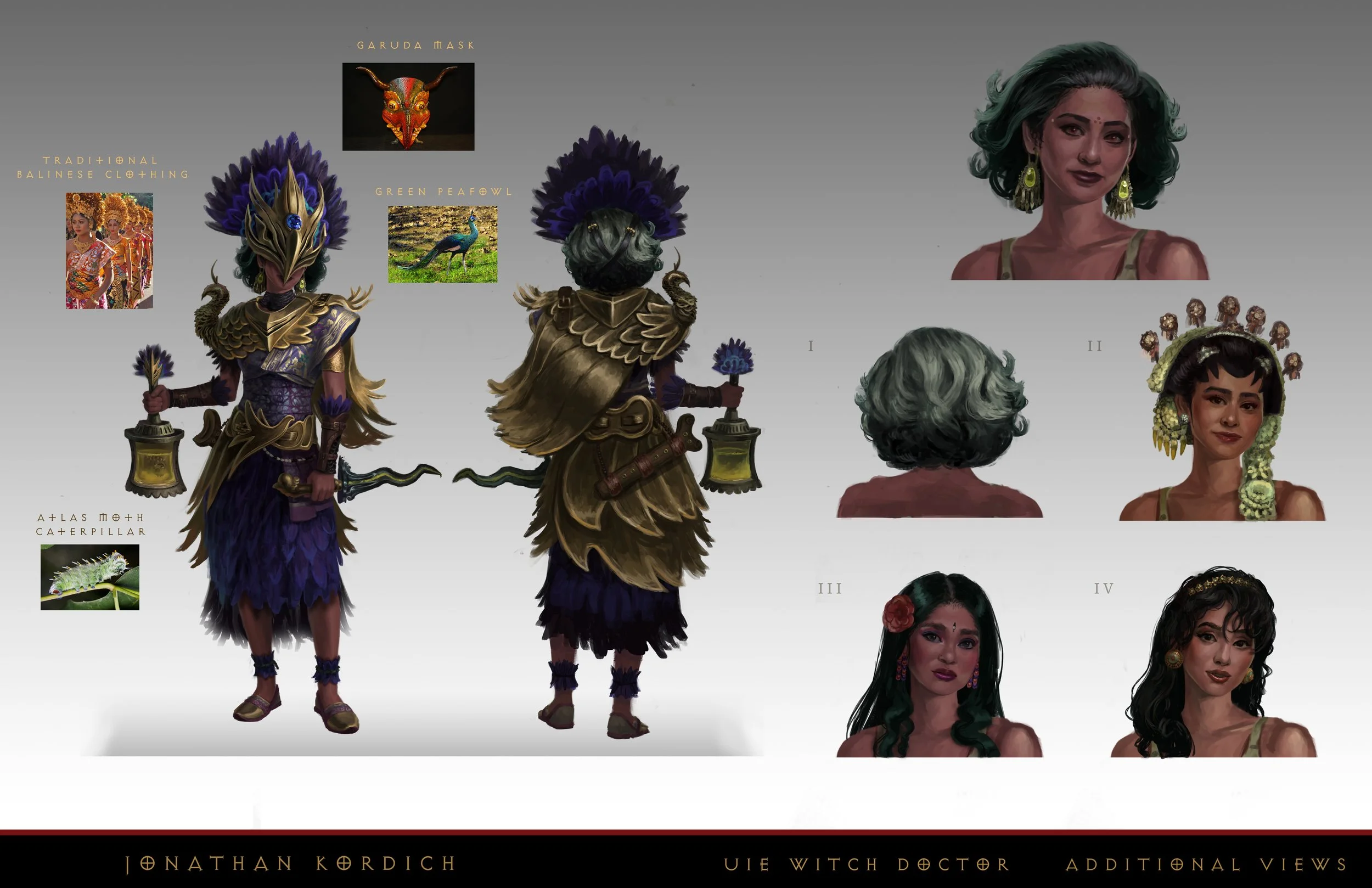
Tarkshya is another name for the avian god Garuda. Balinese masks, all of the regional animals, insects, and birds were the biggest inspiration for this character.
Vampire Hunter D - Redesign project
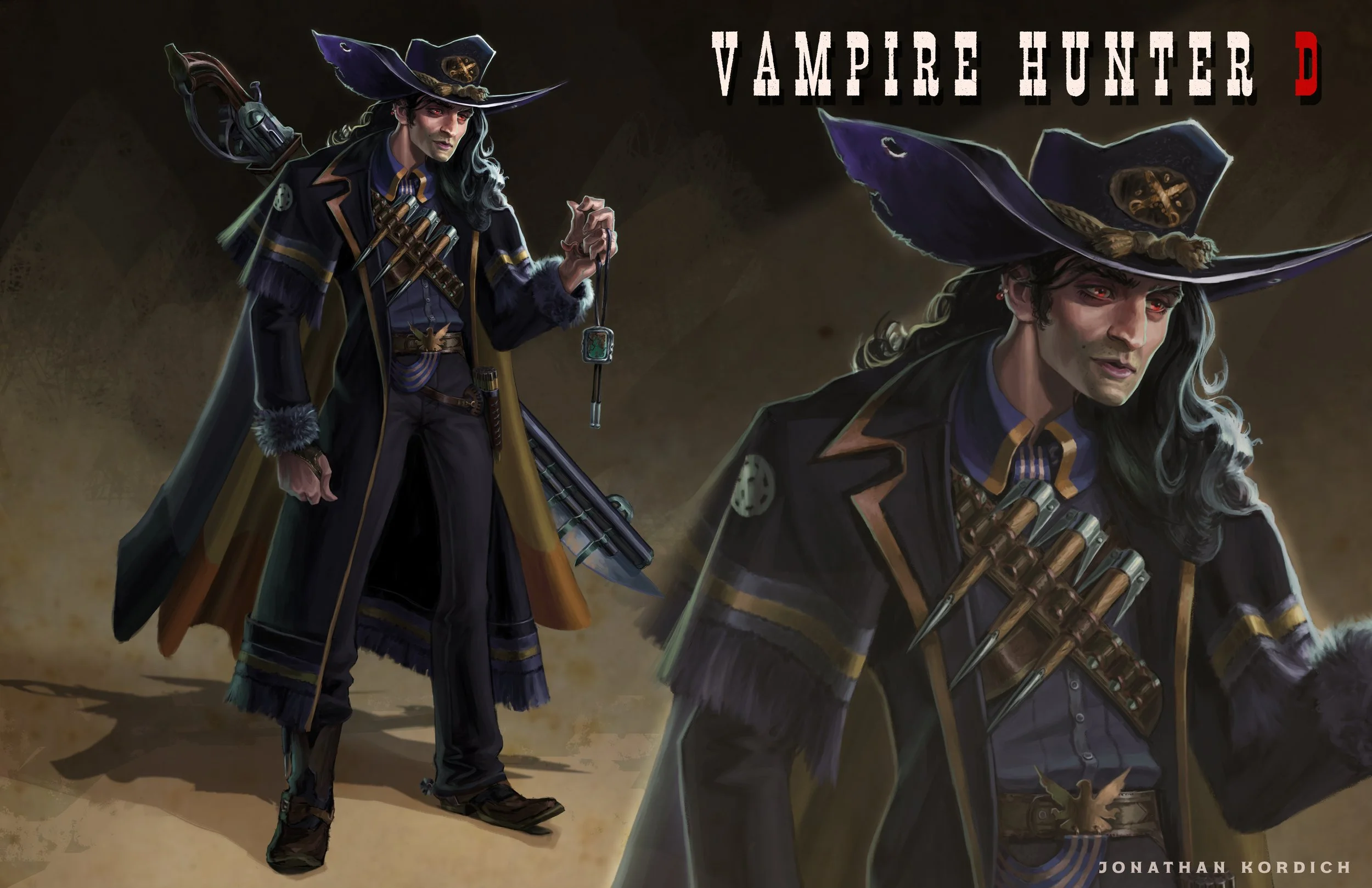
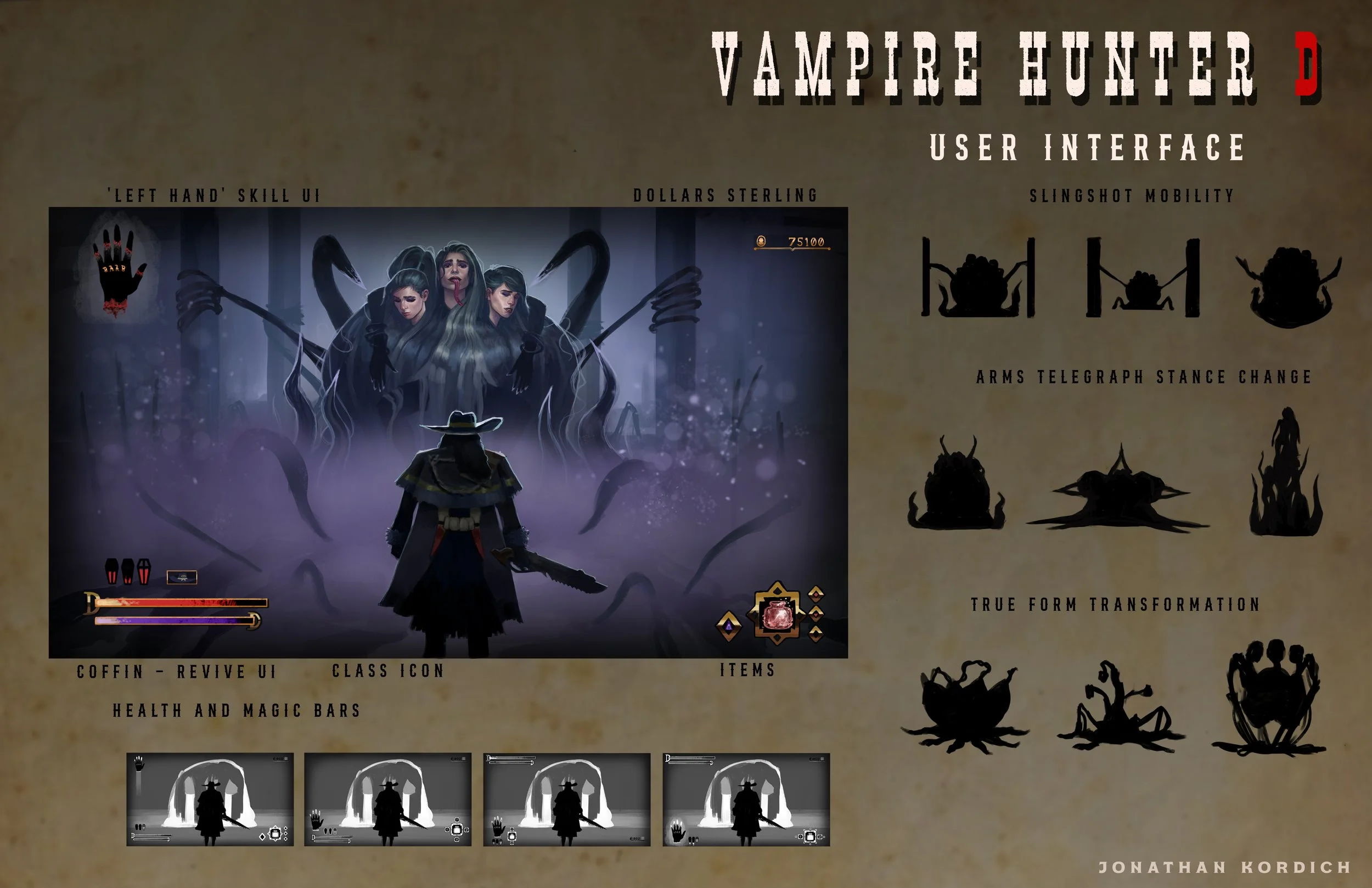
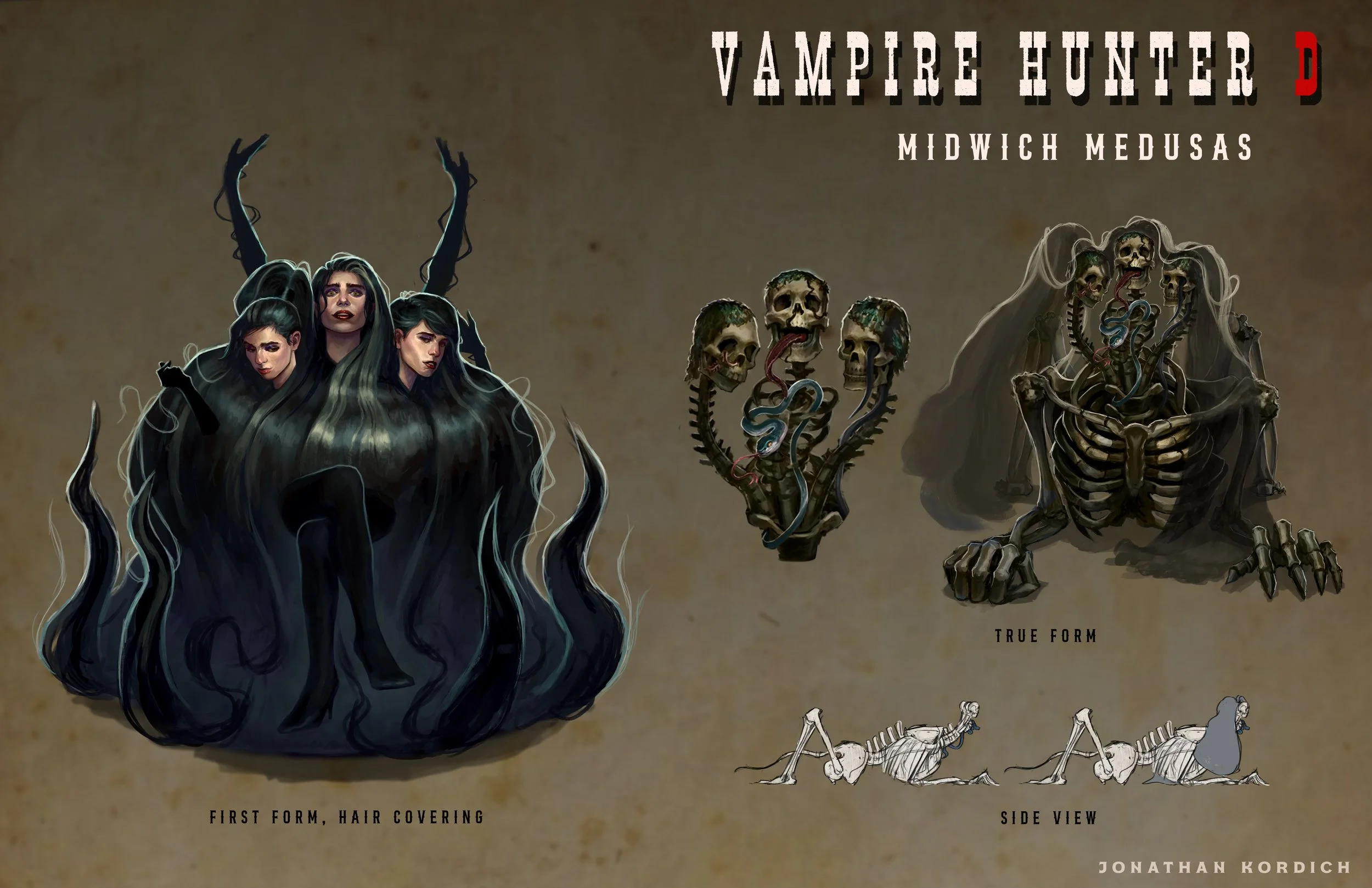
1800’s Western redesign of Vampire Hunter D set in America. Using FromSoftware as the intended studio, I was inspired by Bloodborne’s design aesthetic with Sekiro’s narrative structure.
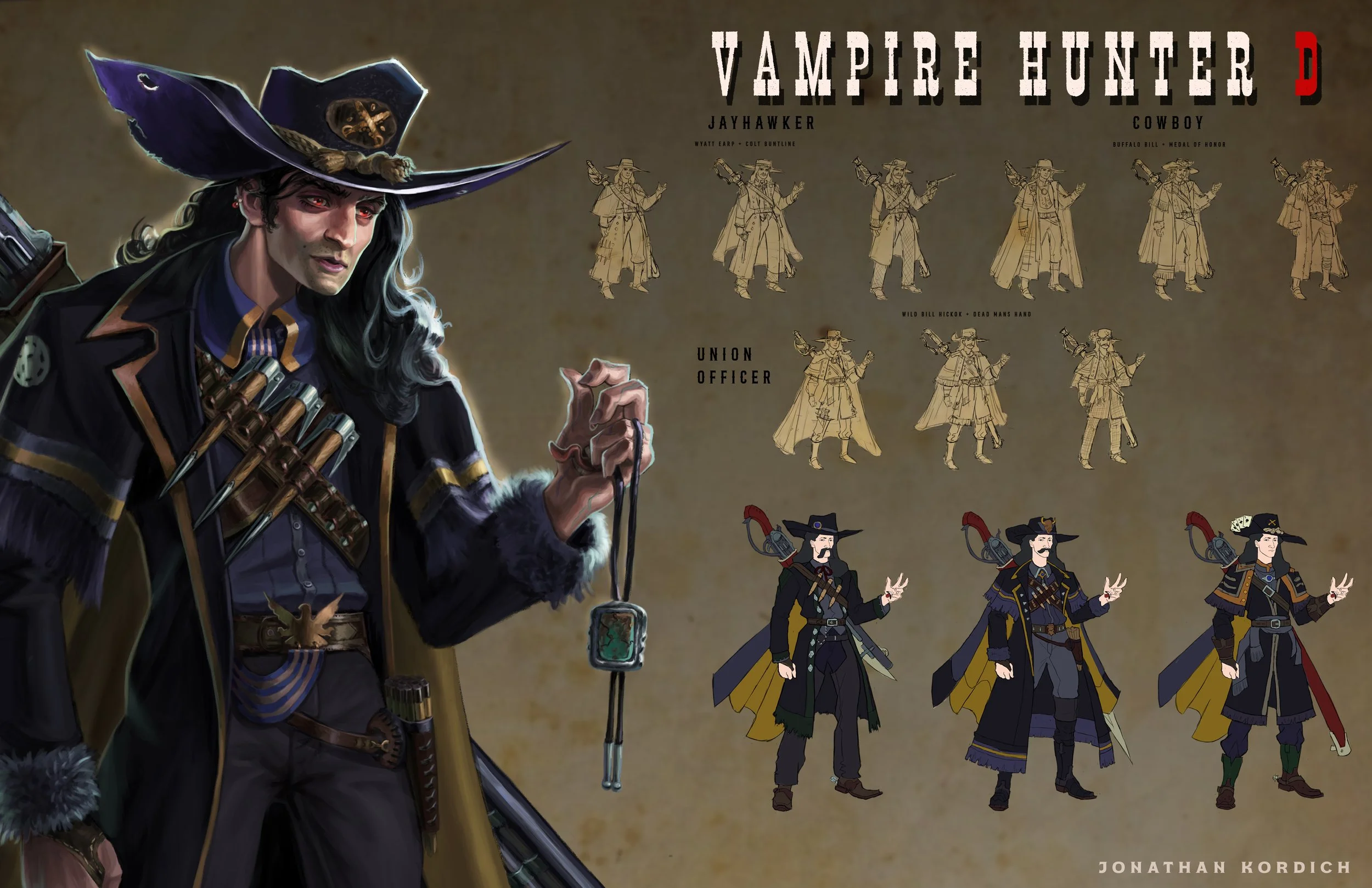
D’s immortal nature was extremely compatible with the legend of Wyatt Earp having never been shot in any gunfight. The outfit was inspired by Union Officers and cowboys with a bit of lone wandering outlaw flair. He’s holding his famous talisman of protection that he gives to Doris at the beginning of the story to protect her. As an homage to two similar characters: the Man with No Name, D is wearing his bracer as well as Sanjuro’s oxalis crest on his duster.
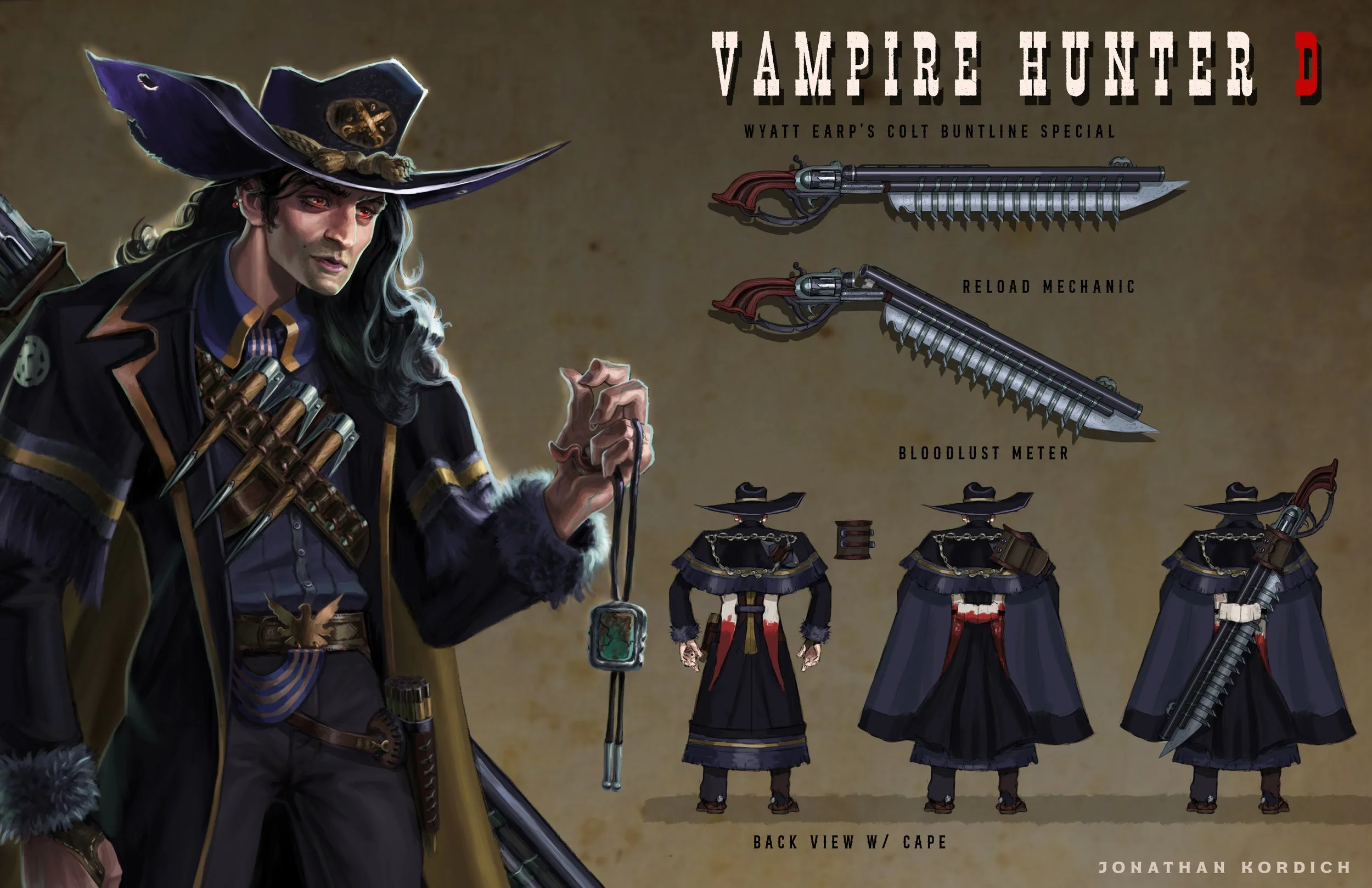
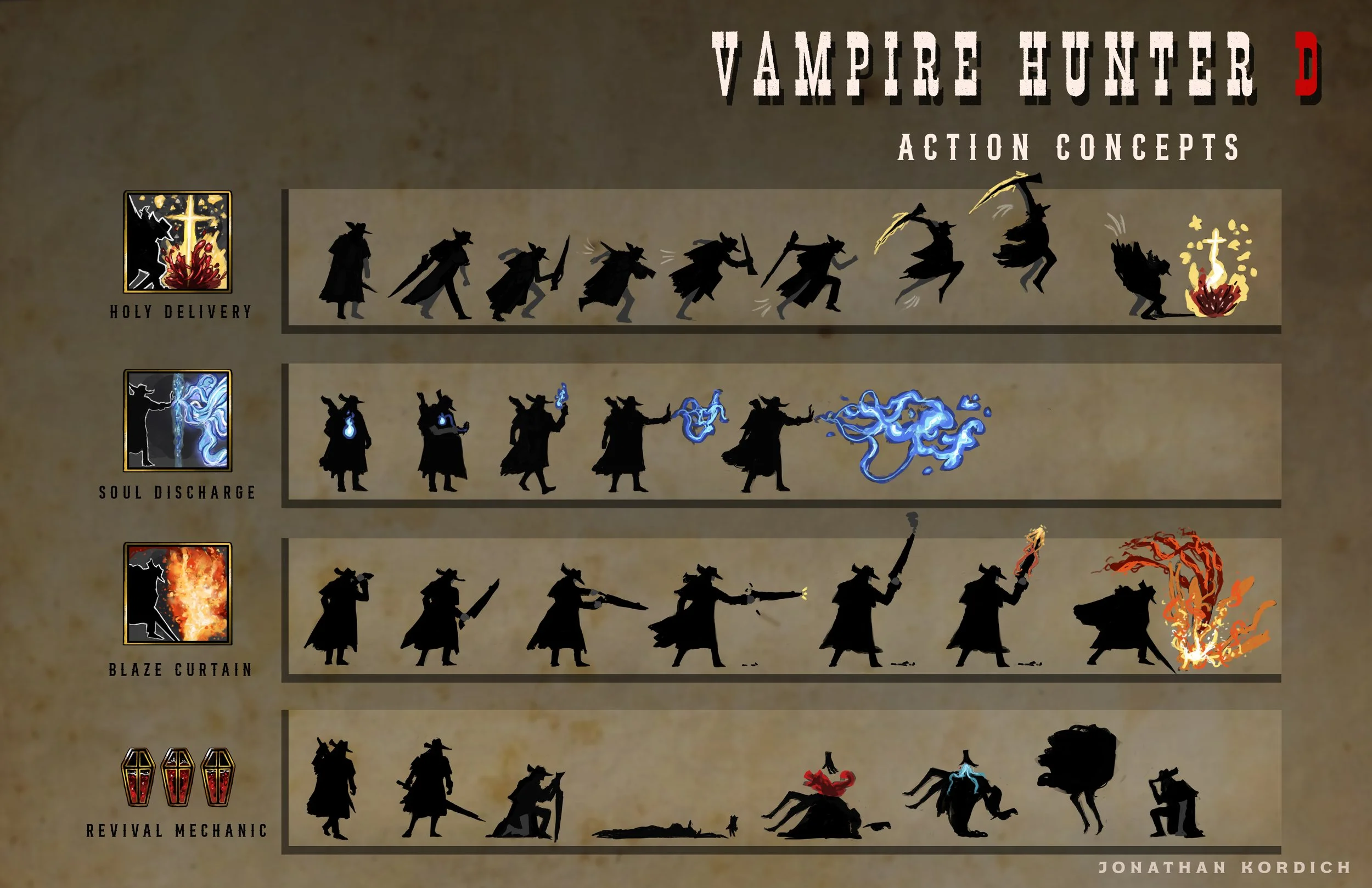
Wyatt Earp’s Colt Buntline Special was his signature revolver that was a modified version of the original with a 12 inch barrel. Since D was known to have an extra long blade on his back, combining the two felt like a perfect match for his character. Many blades are perpendicular to the main sword to create a cross motif along with it becoming a serrated edge for hunting. The teeth on his back fill with blood as a UI element for his bloodlust.
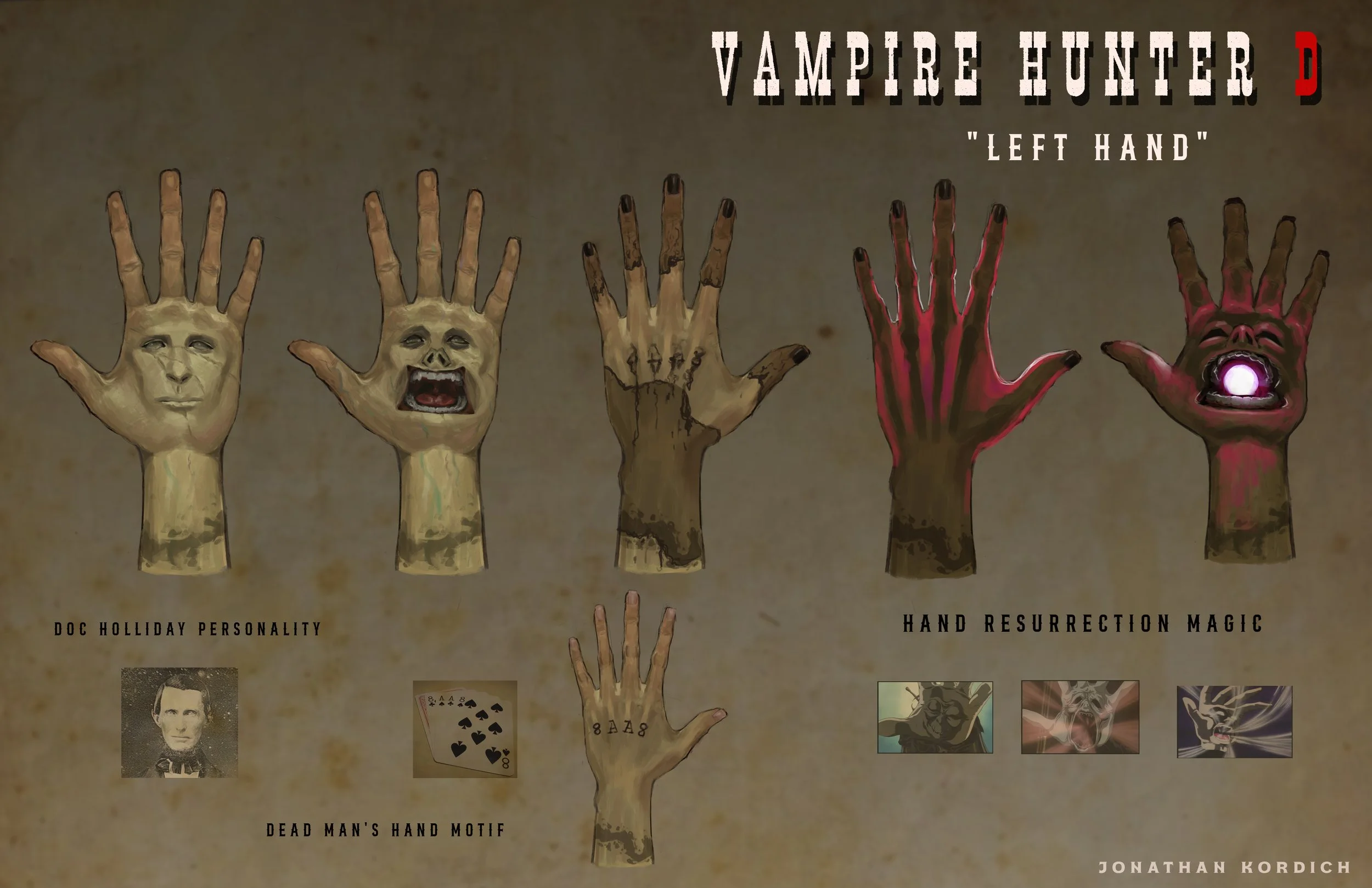
The sassy, crude, and funny attitude of the original Left Hand and inspiration of Wyatt Earp lead to the solution of Doc Holliday being the best candidate as his personality. The dead man’s hand was also perfect for a dead man that could have his detachable hand resurrect him at will.
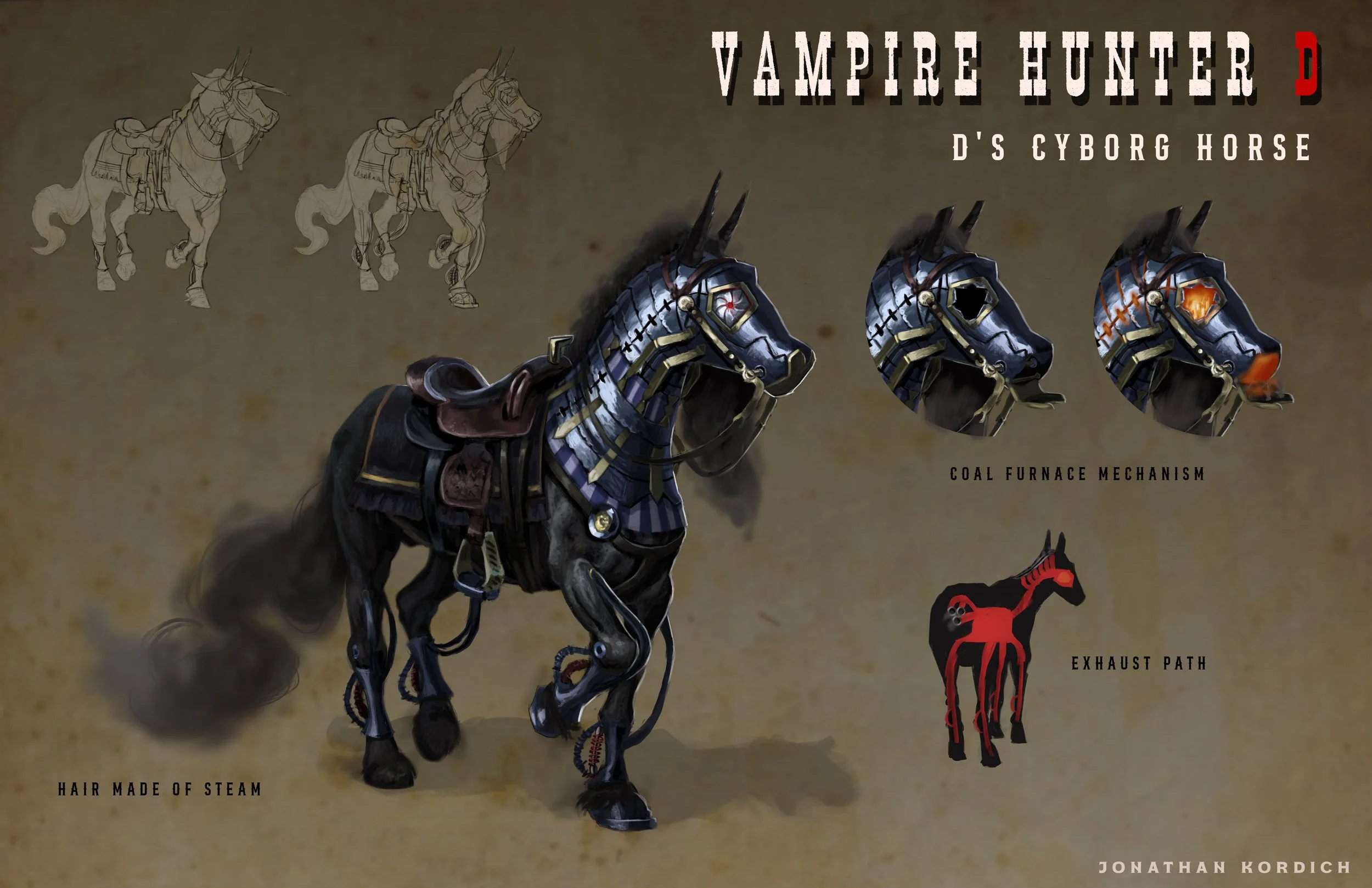
D’s trusty cyborg horse inspired by the steam powered trains of the time. I wanted to keep some of the original’s scifi elements by emphasizing the glowing red eyes, which are actually a result of the coal furnace showing through the camera shutters. I opted for cyborg enhancements on his legs that are also powered by the more analog suspension coils for impact. Bringing a bit more of the fantasy genre aspect/mysterious nature was considered and resulted in changing the horse’s hair out with smoke/smog (tail hair, hair at bottom of legs, and hair on top of head.)
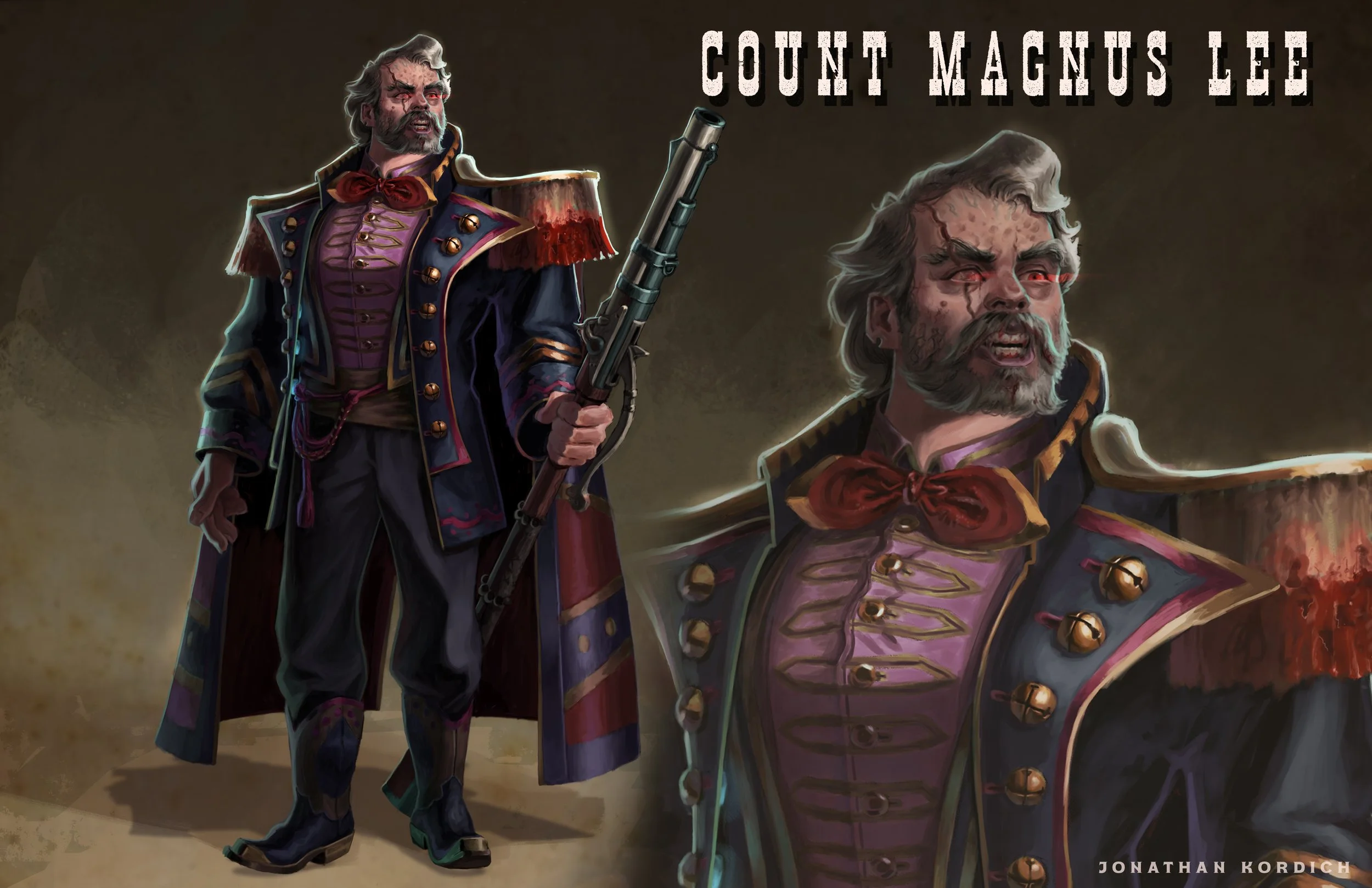
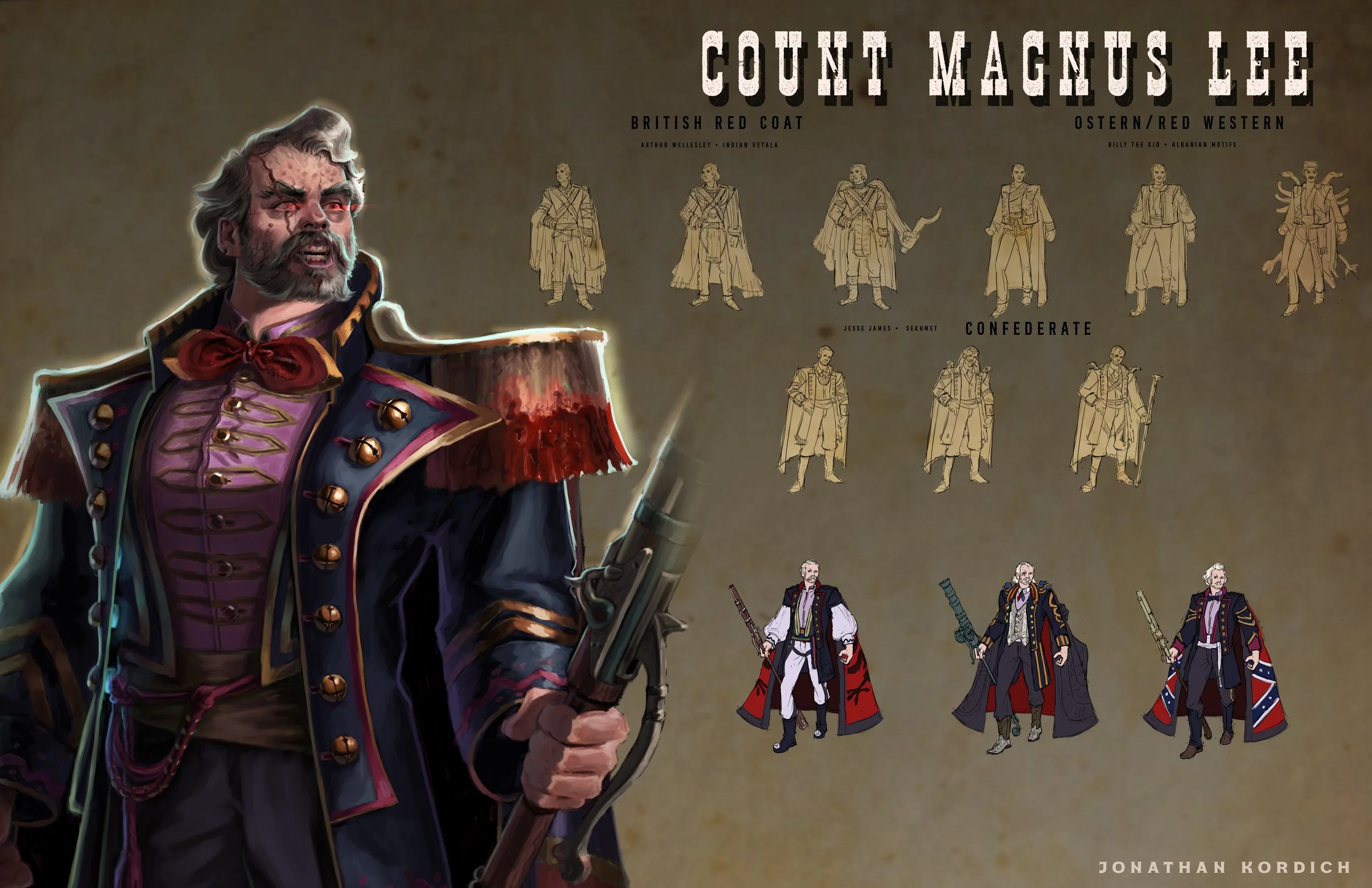
I designed Magnus Lee’s outfit as an amalgamation of British Red Coats from the War of 1812, Confederate officers, Balkan Folk costumes, as well as some tinges of Red Westerns/Osterns that released in Russia as competition to the Westerns in the United States. His facial scars were sustained before becoming a vampire. It features smallpox scars that he contracted abroad before moving to the Frontier.
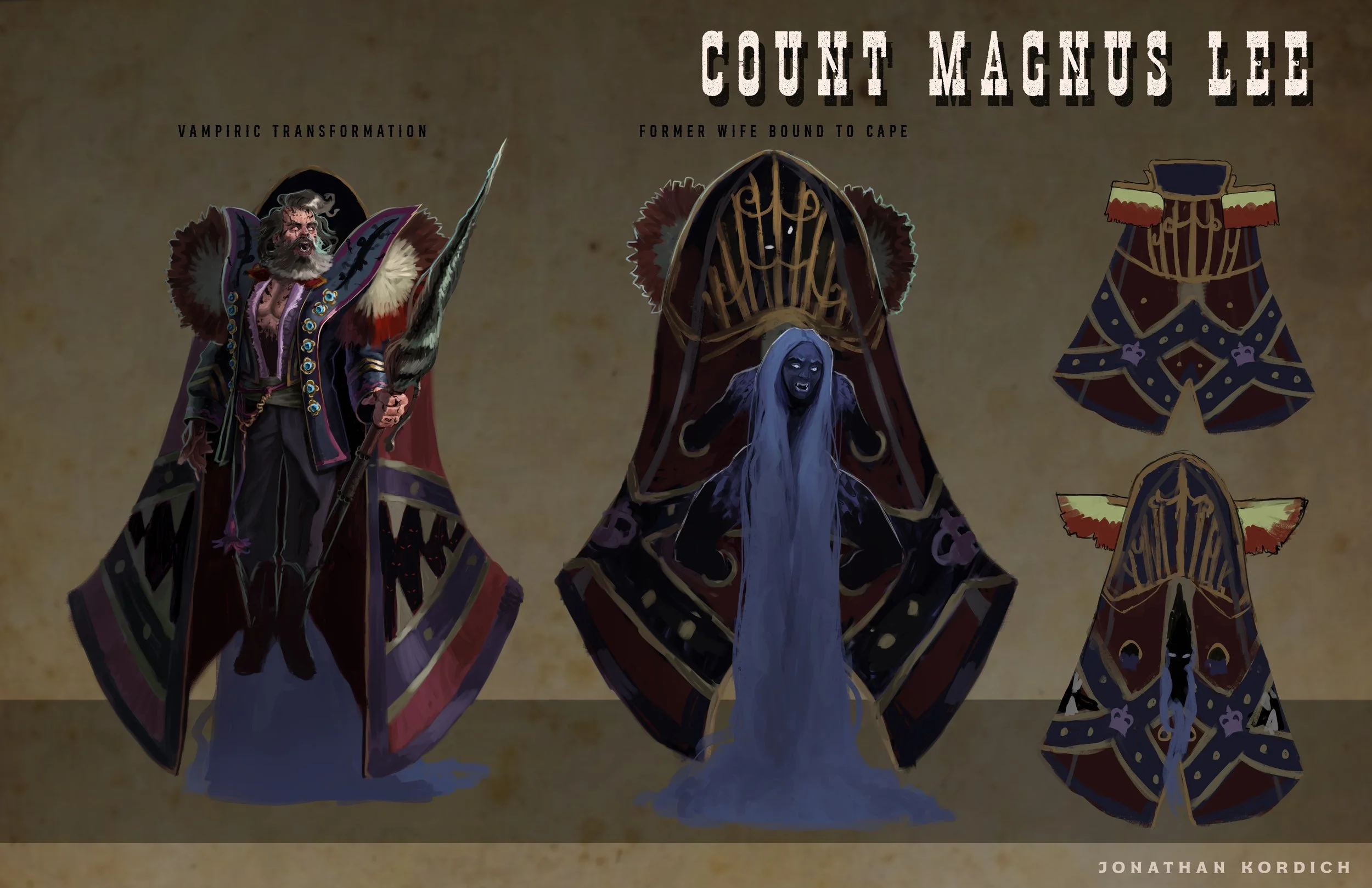
The actual text describes Lee’s cape as having stitched together skin of women who slaked his thirst. I wanted to give a physical representation of that as well as give the answer to the mystery of what happened to his wife, the mother of Larmica. As a boss fight, after Magnus sustains enough damage, his cape will grow and have separate health bars/move sets for front and back.
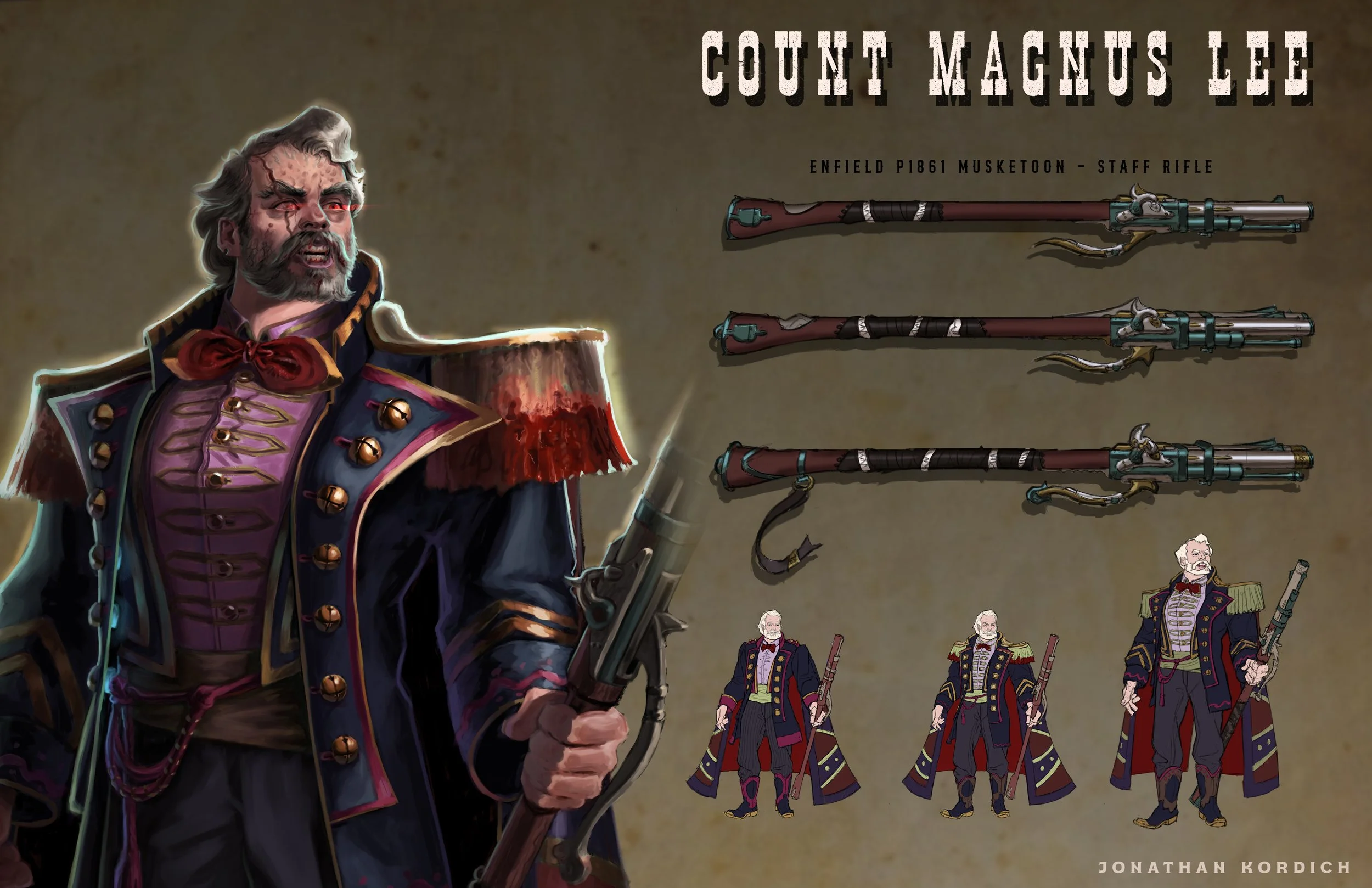
The Enfield was a rifle that was extremely popular by the Confederates during the civil war. I used this as the base for creating a staff rifle to match Vampire Hunter D’s gunblade.
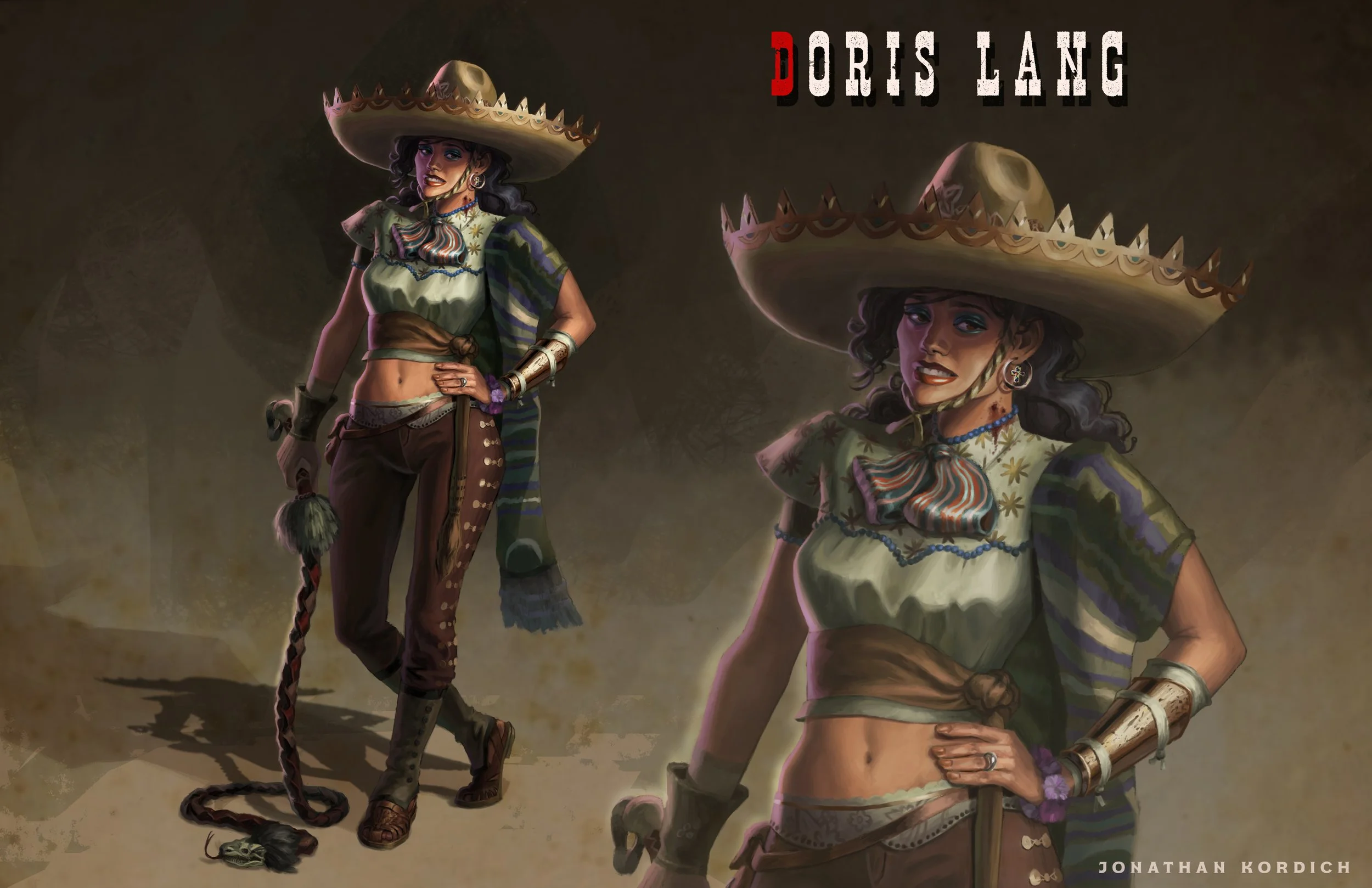
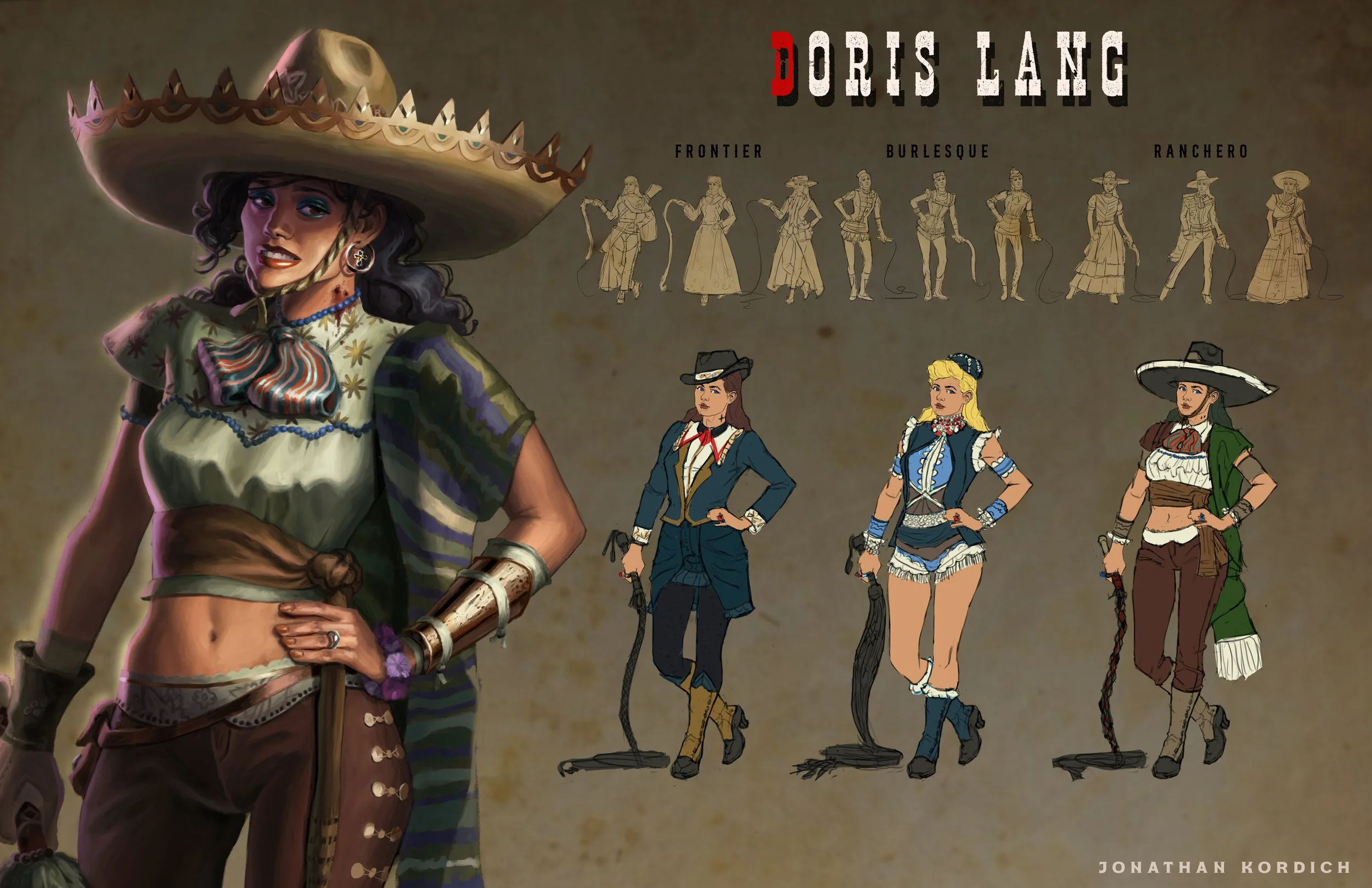
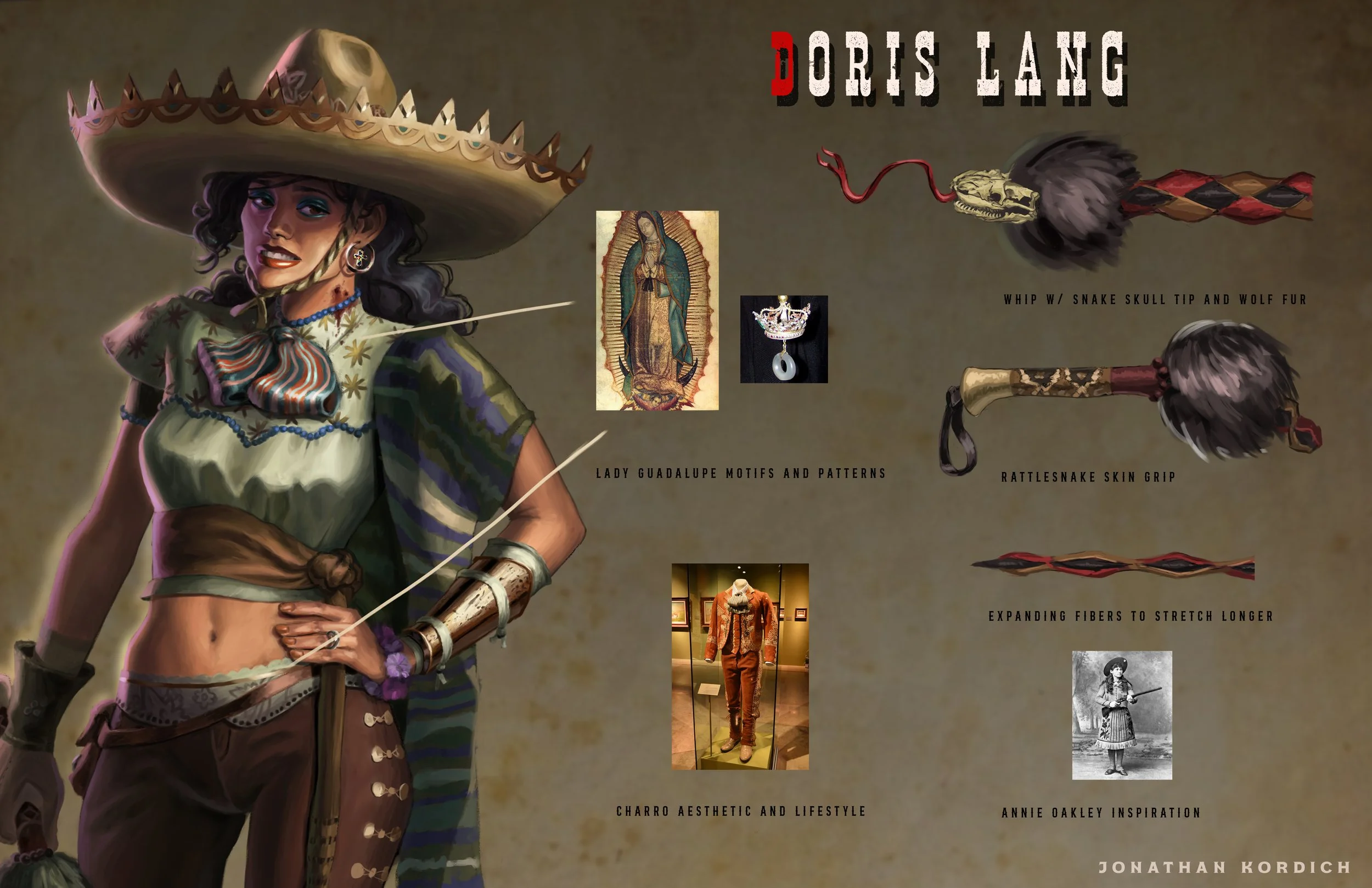
As the daughter of a Werewolf Hunter, Doris is already pretty capable of handling herself. The charro aesthetic felt like a nice contrast from the more American cowboy style that D had and the more aristocratic nature of Magnus Lee. As a natural resistance to vampires, I chose to give her culturally Catholic roots from her family: this is represented by both her cross earring as well as the many Lady Guadalupe motifs on her outfit. In universe, people are unable to remember vampire’s weaknesses once discovered, keeping it as part of her character made it a permanent fixture.
Heavily considered the aesthetic of burlesque dancers (often featured on cigarette cards) that matched her design in the movie, but decided to go with something more practical and closer to her actual role as a farmer’s daughter that took care of her younger brother.
Nausicaa of the Valley of the Wind - Live Action redesign
Live action redesign of Nausicaa. Inspired by dieselpunk, the interwar period, and retrofuturism that the original borrowed from. The Valley of the Wind aesthetic borrows from Greece, while Pejite uses Turkey, and Torumekia’s motifs are from Italy. Staying close within the Mediterranean Sea gave similarities, but have enough cultural contrast to be interesting.
To contrast against Nausicaa’s more symmetrical and lighthearted nature, I chose to make Kushana the opposite of that: asymmetrical and serious. She’s a very stern character who does what she needs to do to further her goals. The original design is much more bulky than this, but I feel like that bulk isn’t really what makes her character stand out. I played with many different types of snake motifs to represent her country as well as everything from Italy, ranging from ancient Rome to World War 2. The spider tailed horned viper has an interesting mechanism where it lures prey into a trap using its tail. I settled on using that as the main motif in her shoulder armor as well as on her sword’s hilt.
Another big focus of the redesign of Kushana was making her prosthetic arm stand out. In the anime, her prosthetics are represented by the pieces of armor still on her when she removes her body armor, helmet, and cape. The Milanese armor was the first thing that I settled on when starting the character, so I tried not to drift too far away from it.
Added a viper-like face mask to complete Kushana’s full armor set. This will let her safely travel through the Sea of Corruption. Her prosthetic arm is also activated with the fan spinning and interior parts glowing.
As such an iconic character, I wanted to design Nausicaa to fit this specific world more than simply be a more believable/functional version of the original film’s costume. Maintaining the aviator role and her bright personality were big considerations of the process. Modern Greek costume motifs were also peppered into the aesthetic along with her insect whistle as a focal point.
Exploring different types of technology for the breathing mask. Hazmat suits, gas masks, underwater rebreathers, firefighter oxygen masks and more were considered. Ultimately decided to go with something very close to the original to keep with it’s unique identity.
The main design inspiration for the glider was looking at retrofuturistic cars and interwar era planes. The center console, safety belts, and diesel exhaust were added for functionality and alignment with the dieselpunk aesthetic. With the final glider looking a bit more like a manta ray, this influenced how the Sea of Corruption and Ohmu would be designed going forward.
Asbel is more of a kind hearted rogue that seeks revenge against the Torumekian Empire. As a vassal state of the empire, I used Turkey’s national animal, the gray wolf, to represent Pejite being caged behind the horizontal bars. I opted to keep a more square aesthetic to contrast against Nausicaa’s triangular motifs. Many of the other design flourishes were influenced by clothing of the Ottoman Empire.
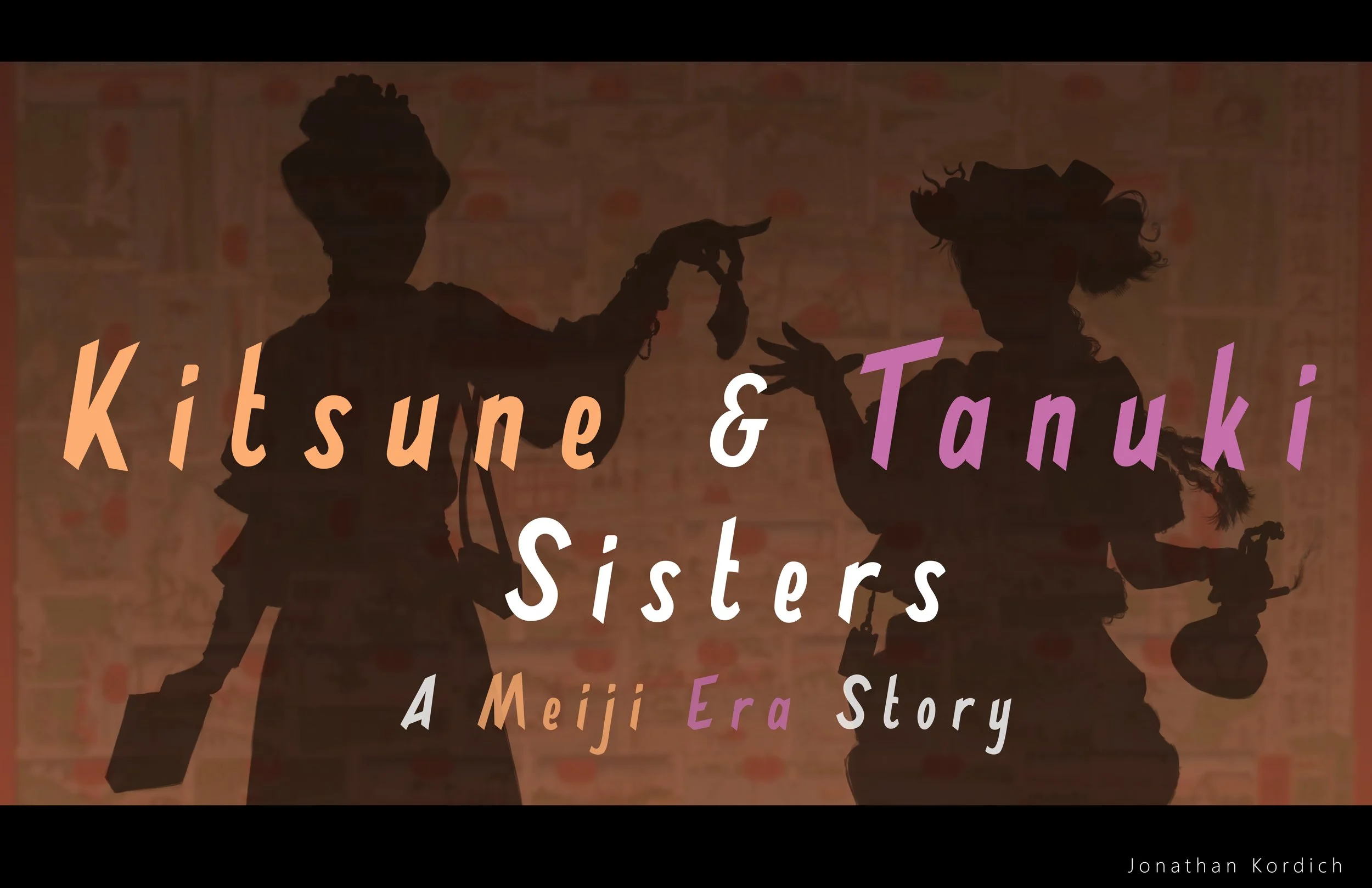
kitsune & tanuki sisters - personal project
A story of two sisters possessed by Yokai in Meiji Era Japan. The prominent way to get rid of Tanuki possession is by worshiping them until they ascend to godhood. Begging the assistance of Tamamo-no-Mae, the eldest allows herself to be used as a vessel in order to start a cult of the Tanuki. The printing press, the telegram operators, and modern day advertising will be a good start to boost the numbers.
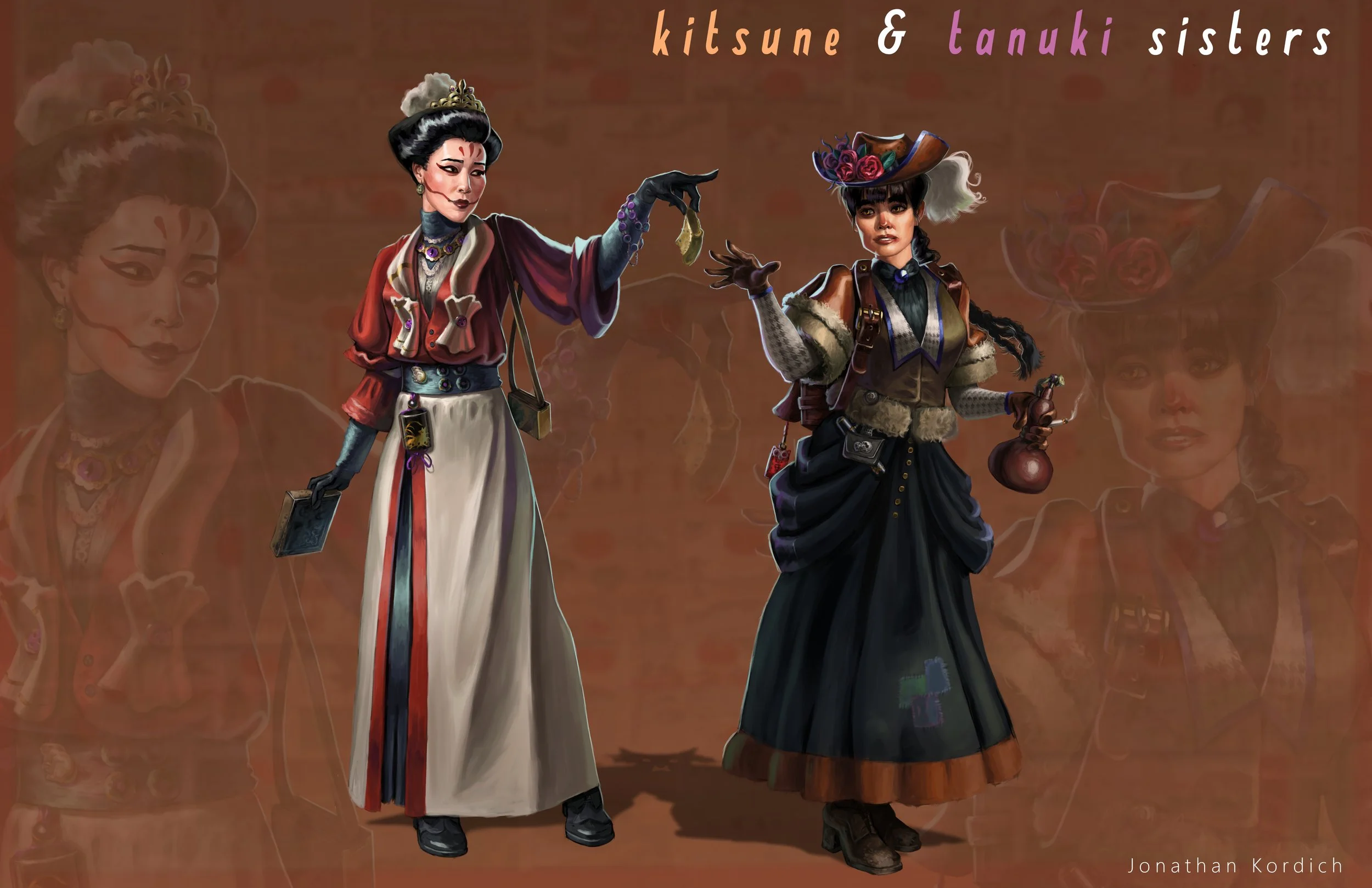
Meiji Era Japan is defined by its aesthetic of mixing both Western style clothing along with traditional Japanese garb. The design for the elder sister was intended to look more proper, traditionally Japanese, and well put together. Using the colorways of a fox (kitsune) as a base and adding more regal elements like a crown and other jewelry. The younger sister’s design philosophy is to use far more Western/European articles of clothing, add details of sloppiness/dirtiness, and the overall colorway of tanuki’s (raccoon dogs.) The added alcohol gourd, cigarette, and complexion show additional signs of Tanuki possession, as the victim becomes gluttonous and unkempt.
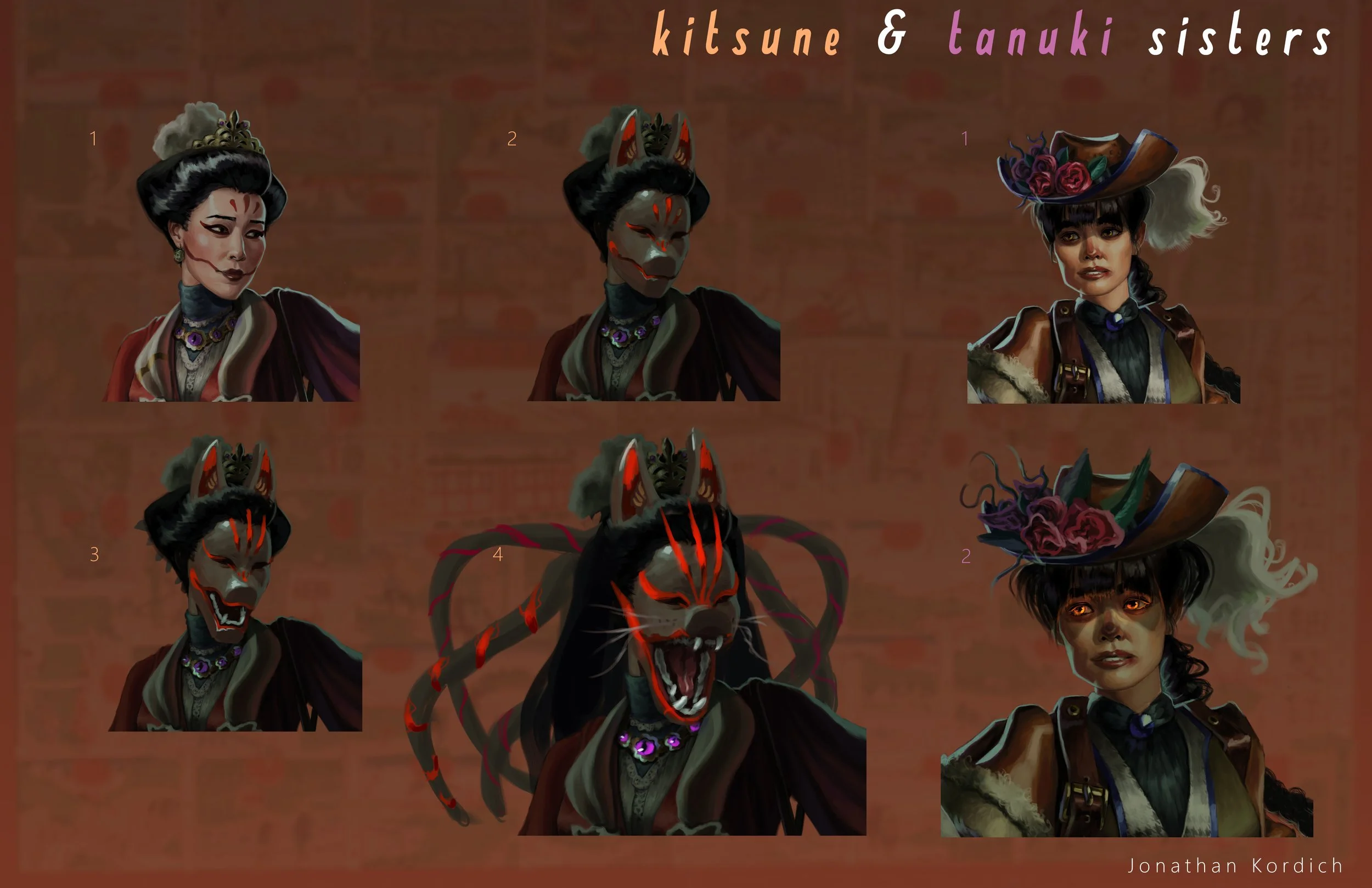
Transformation ideation on what the characters would look like if the Yokai completely take over.
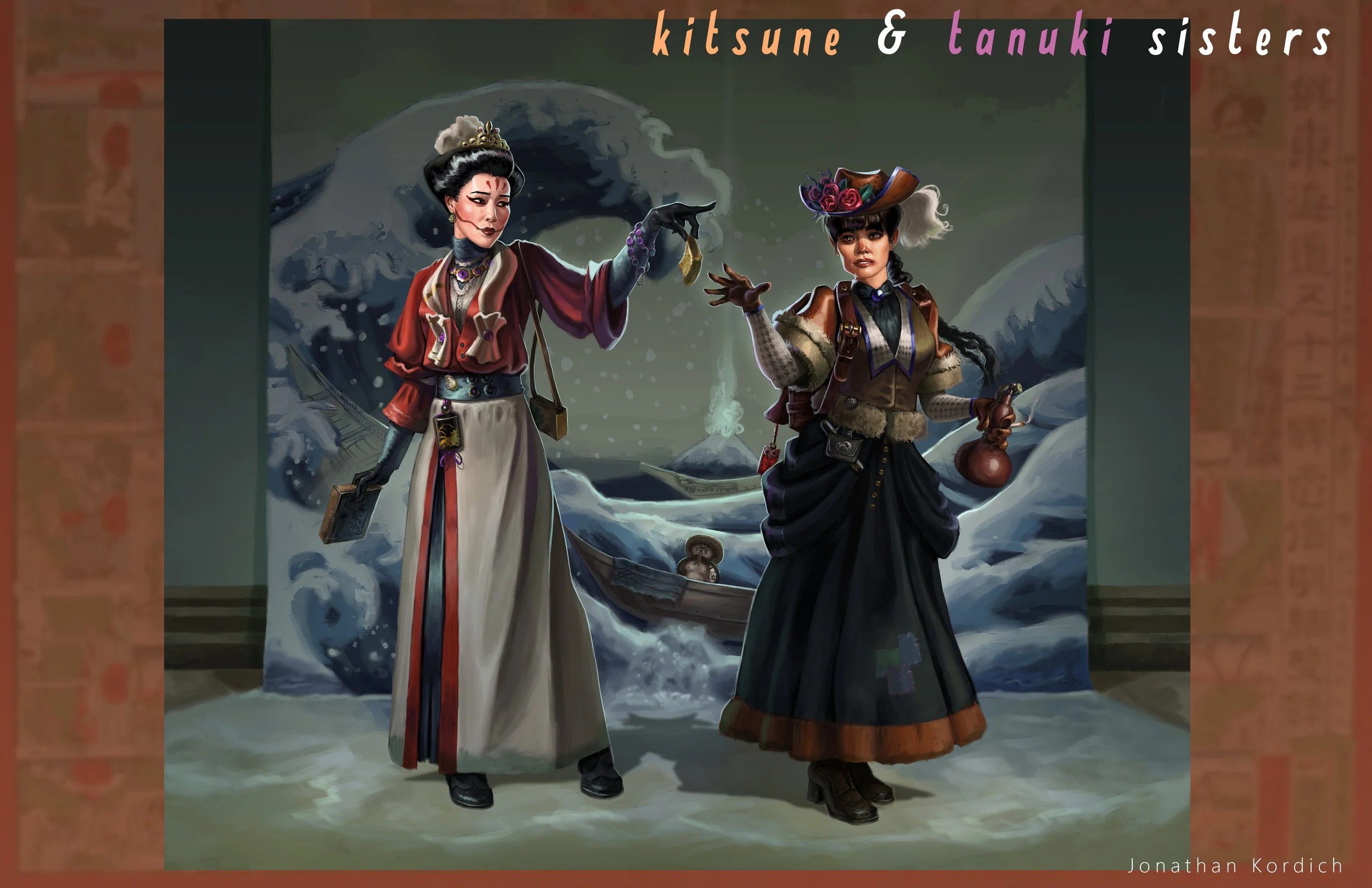
The Kitsune sister leads her younger sibling with fried tofu, a Tanuki’s favorite snack. The Yokai’s meddling in their photoshoot is sure to cost a pretty penny.